
At a glance
Where Culture Fades investigates under-activation of cultural representations in text-to-image models. It traces where cultural information weakens, identifies sparse culture-related neurons, and tests inference-time activation and targeted enhancement. CultureBench connects these internal analyses to the cultural fidelity of generated images.
The study distinguishes possessing a representation from successfully expressing it. It examines whether changing the activation of existing knowledge can improve culture-specific generation while tracking generation quality and diversity.
- Representative models analyzed
- 2
- Culture-sensitive neurons
- Sparse
- Complementary alignment strategies
- 2
Research question
Visual realism and semantic alignment do not ensure that images preserve the cultural connotations of a prompt across languages.
Method
- Analyze cultural consistency under multilingual prompts in representative text-to-image models.
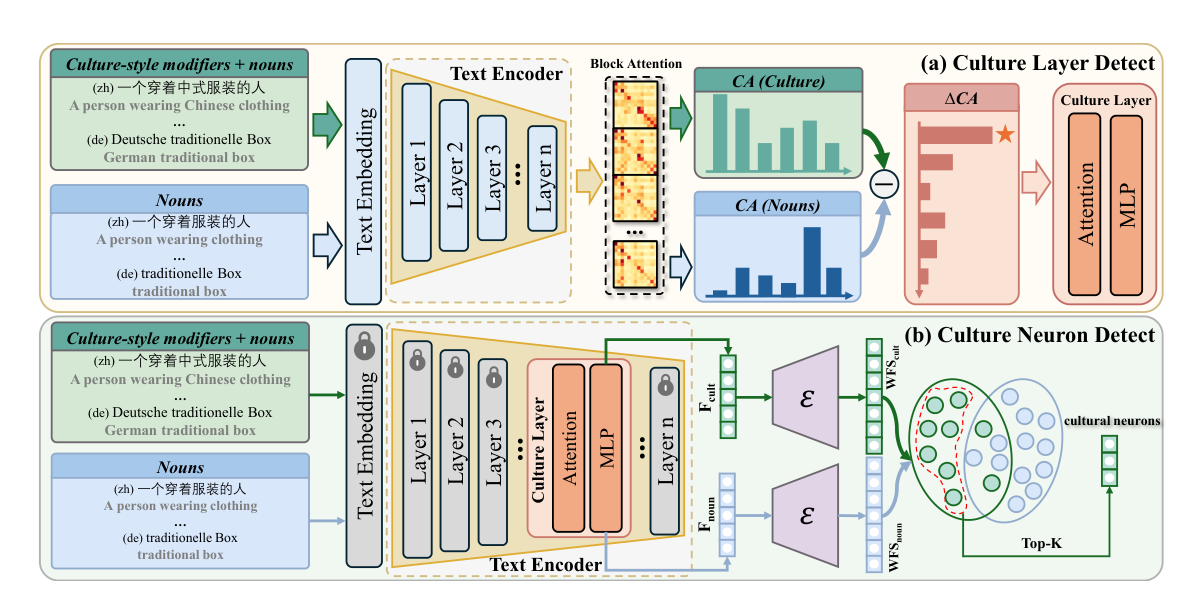
- Probe a small set of culture-sensitive neurons concentrated in selected layers.
- Amplify selected neurons at inference time or update only culturally relevant layers.
 Enlarge ↗
Attention differences localize culture-sensitive layers, followed by sparse neuron detection.
Paper, p. 4Evidence
Analyses of two representative models support under-activation rather than simply missing knowledge. CultureBench evaluations report improved cultural consistency while preserving fidelity and diversity.
 Enlarge ↗
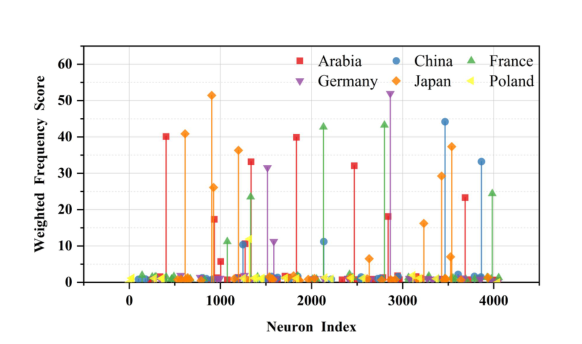
Neuron-frequency peaks illustrate the concentration of culture-related responses.
Paper, p. 5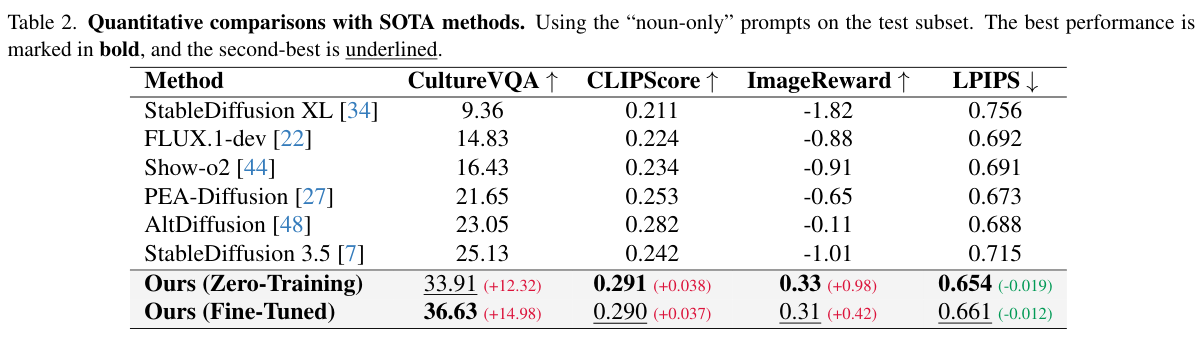 Enlarge ↗
CultureBench metrics compare cultural fidelity alongside other generation measurements.
Paper, p. 7Takeaways
This distinction matters whenever a model’s output is used to judge the scope of its knowledge. A generic image may reflect weak access to cultural detail, incomplete knowledge, or both. Internal analysis makes those explanations more separable and enables a more specific intervention.
The broader goal is culturally faithful generation grounded in identifiable mechanisms and measured outcomes. The reported findings establish a direction within the tested models and cultural coverage, while richer local evaluation remains essential for understanding what fidelity means across communities.
Cultural knowledge can be present in a model yet fail to shape what it generates.
Paper and resources
Where Culture Fades: Revealing the Cultural Gap in Text-to-Image Generation
Paper contact · cshi0459@uni.sydney.edu.au