
At a glance
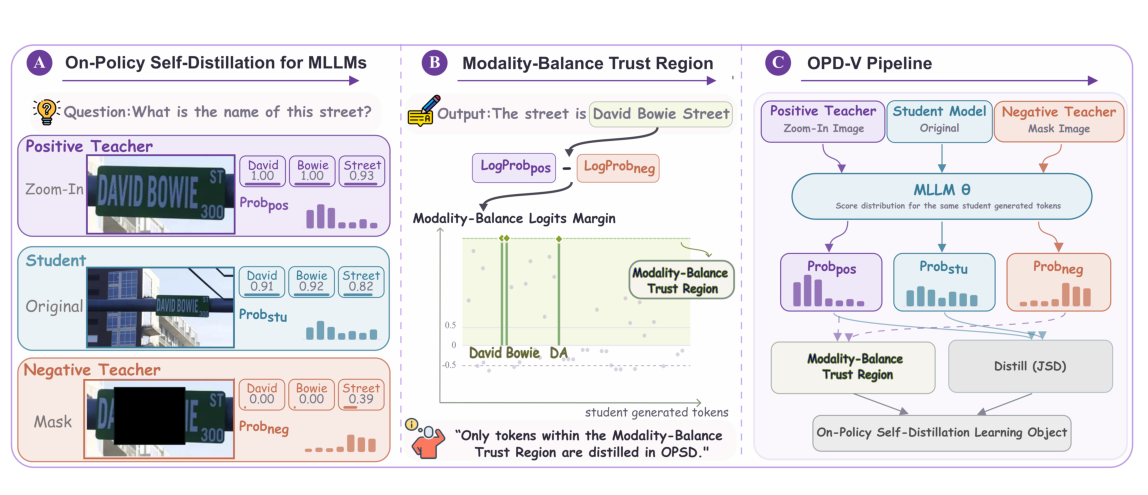
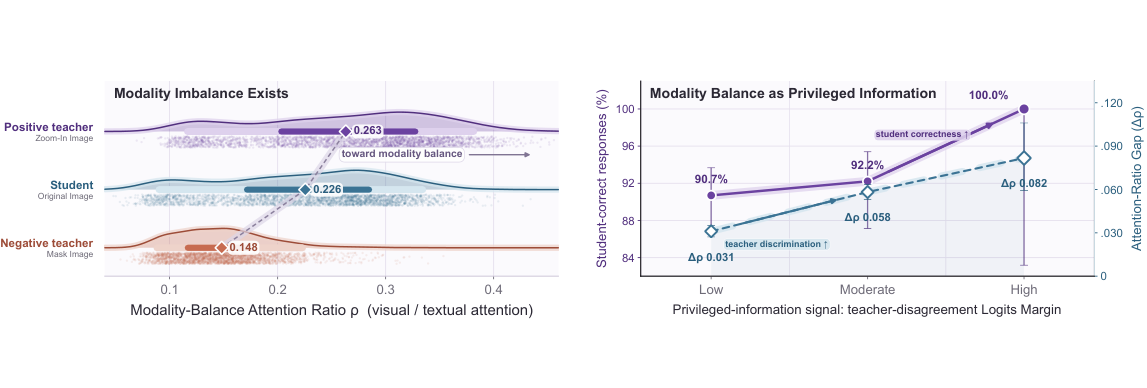
OPD-V examines modality imbalance in visual on-policy self-distillation. A teacher can be confident while relying mainly on textual context, leaving the additional visual information underused. The method contrasts a zoom-in positive teacher with an image-masked negative teacher under matched text and student-generated prefixes.
Their token-logit margin defines a modality-balance trust region. Distillation focuses on tokens for which the positive visual condition supplies stronger support, connecting the selection of supervision to evidence use rather than treating every confident teacher output equally.
- Evaluation benchmarks
- 6
- Multimodal backbones
- 4
- Post-training methods
- 5
Research question
Privileged information improves training only when the teacher effectively uses it. In a multimodal model, confidence and correctness alone may not reveal whether an apparent reasoning signal depends on the image.
Method
- Score the same student-generated tokens with the original-image student, zoom-in positive teacher, and masked-image negative teacher.
- Use positive modality-balance logit margins to select an on-policy trust region.
- Apply Jensen–Shannon self-distillation from the positive teacher on the selected tokens and compare quality and training cost.
 Enlarge ↗
Positive and negative teacher conditions define a token-level trust region for on-policy distillation.
Paper, p. 3Evidence
Experiments span six benchmarks, four multimodal backbones, and five post-training methods. Analyses compare attention balance and teacher behavior, training dynamics, component ablations, and wall-clock step time. The reported results support the proposed supervision-selection criterion in those settings.
 Enlarge ↗
The analysis links visual-attention balance, teacher behavior, and the proposed privileged signal.
Paper, p. 2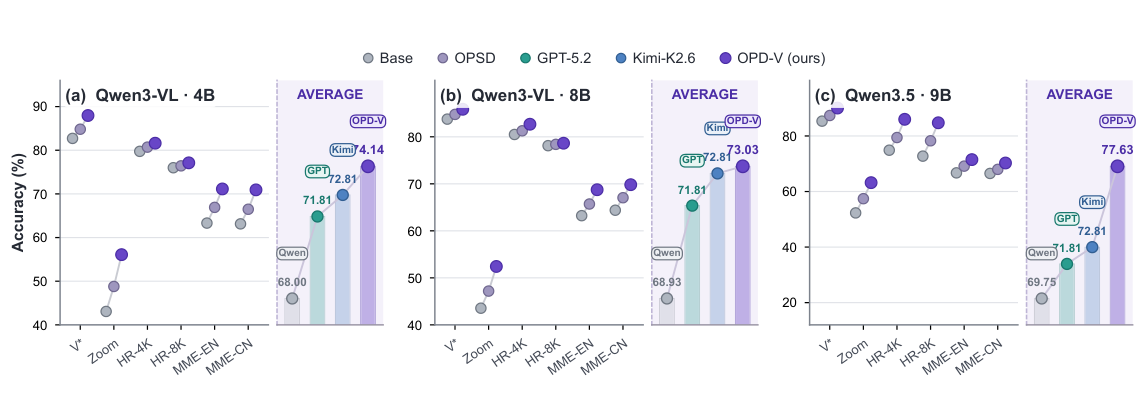 Enlarge ↗
The source plots compare benchmark accuracy across model architectures and post-training methods.
Paper, p. 7Takeaways
The work treats the quality of supervision as partly a question of information dependence. Contrasting visual conditions helps identify where a teacher’s support is associated with richer visual input, providing a practical way to use that distinction during training.
This connects evaluation and optimization: a diagnostic of modality use becomes a criterion for selecting which updates to trust. The larger question is when that criterion continues to track genuinely useful evidence across image transformations, tasks, and model families.
A useful distillation signal should reward how a teacher uses visual evidence, alongside what it predicts.
Paper and resources
OPD-V: Visual On-Policy Self-Distillation with Modality Balance
Paper contact · aniri@dbs.ifi.lmu.de