
At a glance
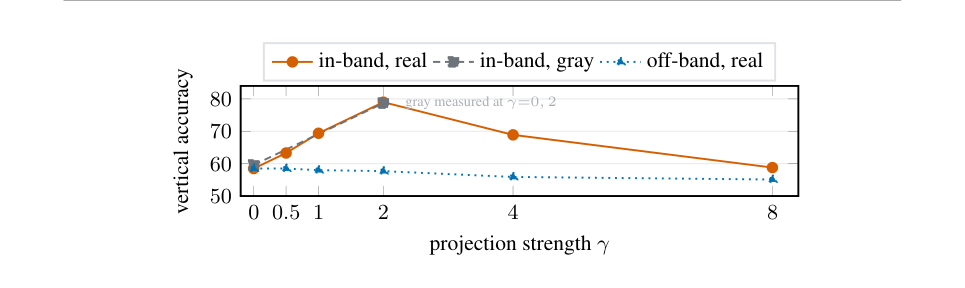
This study examines a familiar interpretability signature: a probe decodes the answer, and steering improves performance. In VLM spatial reasoning, that combination can conceal a directional prior that persists when the image is replaced by a gray blank. The apparent recovery can therefore overstate visual grounding.
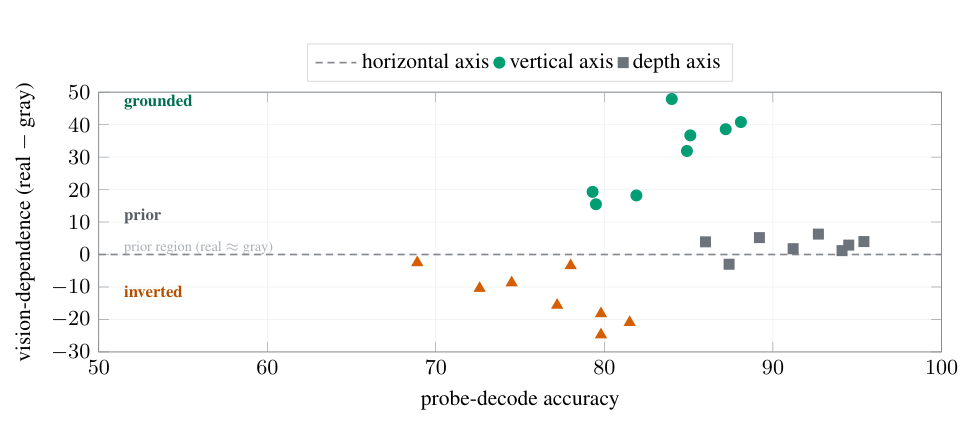
The vision-ablation arbiter separates three regimes: grounded and correct, vision-independent prior, and visually dependent but inverted deployment. In the last regime, information is decodable and behavior is controllable, yet the model uses the relevant direction with the wrong sign.
- VLMs examined
- 14
- Language-model families
- 6
- Grounded, prior, inverted
- 3 regimes
Research question
A model can expose a linearly decodable label without using the intended evidence in its deployed computation. Demonstrating that a representation exists and can affect output leaves a further question: does its behavioral effect depend on the visual input?
Method
- Compare spatial-task behavior with probe decodability and controlled representation interventions.
- Replace or disrupt the visual input while retaining the task, using blank-image and additional ablation controls.
- Classify the resulting grounding regime and examine which minimal representation edit corrects inverted deployment.
 Enlarge ↗
Each point relates probe accuracy to the behavioral effect of removing the image.
Paper, p. 2Evidence
The study examines fourteen VLMs across six language-model families and separates grounding regimes across spatial axes. Additional tests compare several vision ablations and investigate decode-versus-deploy inversion across model families. Intervention results show that the correction needed can range from a training-free rotation to a learned low-rank edit, depending on representation geometry.
 Enlarge ↗
The plot compares steering with real and blank images to test whether recovery depends on vision.
Paper, p. 5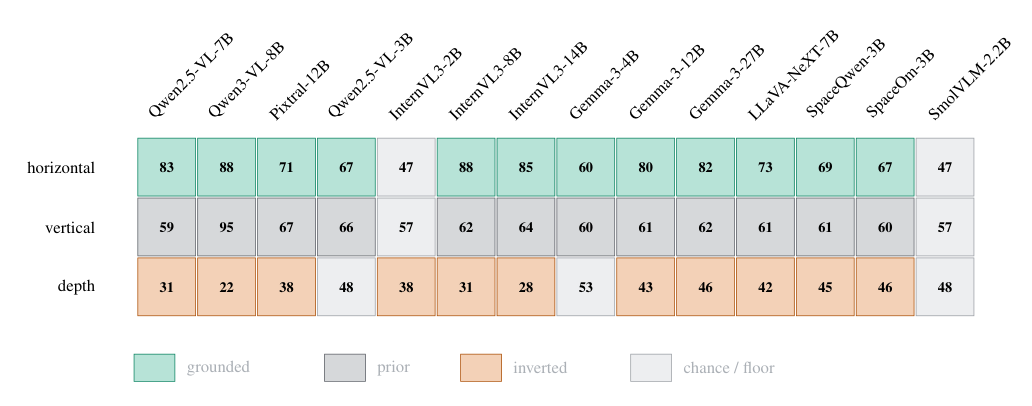 Enlarge ↗
The original matrix summarizes spatial-axis behavior and grounding regimes across fourteen VLMs.
Paper, p. 7Takeaways
The work separates four pieces of evidence that are easy to conflate: information can be decoded, an intervention can control output, the output can be correct, and the decision can depend on the image. A stronger account of latent knowledge needs to state which of these has actually been demonstrated.
This makes a simple counterfactual especially valuable. Removing visual evidence can challenge an otherwise convincing probe-and-steering story, while additional ablation controls test whether the result reflects an artifact of the blank input. The broader lesson is to make grounding a measured property of the deployed computation.
Decoding or steering a representation does not establish that the model used the image to make the decision.
Paper and resources
Decodable Is Not Grounded: A Vision-Ablation Arbiter for VLM Spatial Reasoning
Paper contact · mill.liao@unsw.edu.au