
At a glance
This study separates whether a model answers correctly from how consistently its internal knowledge survives controlled changes in the question. Local state stability and relational geometry offer complementary views of that consistency. EpiStableBench tests paraphrase, format, context, and language variations, making the gap between a successful answer and a stable knowledge state measurable.
The resulting picture is more informative than accuracy alone. Items that look equivalent at the output can differ in their internal stability and in their subsequent correctness. The study also explores using latent stability to guide preference optimization, connecting diagnosis to a possible intervention.
- Knowledge items
- 4,411
- Controlled queries
- 76,766
- Language models
- 16
Research question
Output accuracy alone cannot determine whether an answer rests on stable representations. Controlled changes in how knowledge is elicited provide a way to examine the support behind the answer.
Method
- Average representations within each elicitation condition and correct shared shifts relative to a baseline.
- Use LSS for normalized state displacement and KTS for cross-condition consistency of pairwise distances.
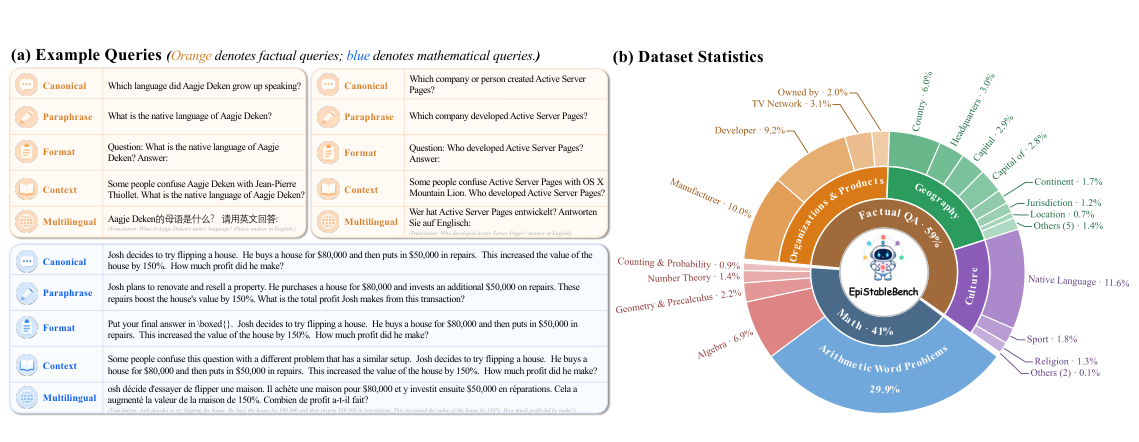
- Evaluate controlled queries in EpiStableBench and use stability-aware preferences in LatentDPO.
 Enlarge ↗
EpiStableBench varies the elicitation conditions while controlling the underlying knowledge item.
Paper, p. 5Evidence
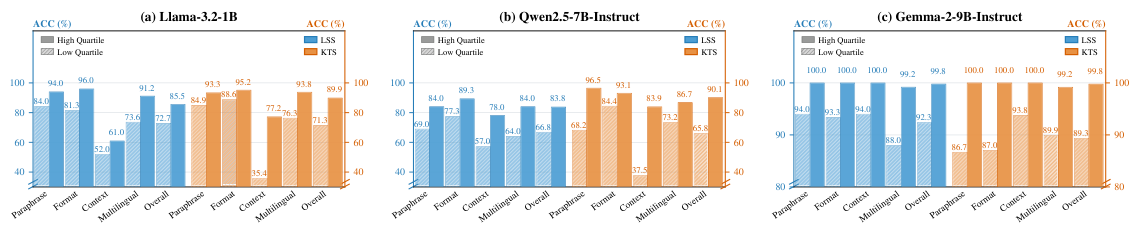
EpiStableBench includes 4,411 items and 76,766 controlled queries. Across 16 LLMs, higher within-model stability generally accompanies better held-out accuracy, while larger or more accurate models are not consistently more stable. LatentDPO improves editing success and generalization in the evaluated integrations.
 Enlarge ↗
Among initially correct items, higher-stability groups show different subsequent accuracy under held-out elicitation conditions.
Paper, p. 6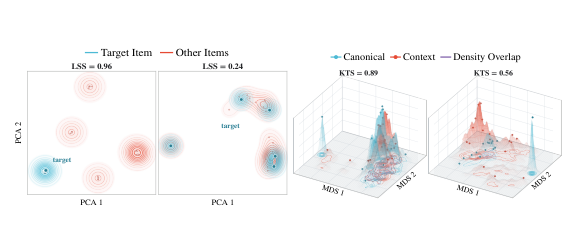 Enlarge ↗
Local state concentration and relational overlap illustrate complementary aspects of internal knowledge stability.
Paper, p. 8Takeaways
Reliable evaluation needs to characterize the conditions under which knowledge remains accessible. A single correct response can conceal sensitivity to how the same information is elicited. Internal stability provides an additional axis for diagnosing that fragility and selecting cases for further scrutiny.
This opens a route toward evaluation that connects representation, elicitation, and behavior. The relationship must be calibrated within its setting: scores across different models are not automatically comparable, and a geometric indicator is evidence about reliability rather than a guarantee of truth.
A correct answer is one observation; stable knowledge is a property of the representation behind it.
Paper and resources
Do correct answers have stable latent knowledge support?
Paper contact · cshi0459@uni.sydney.edu.au