
At a glance
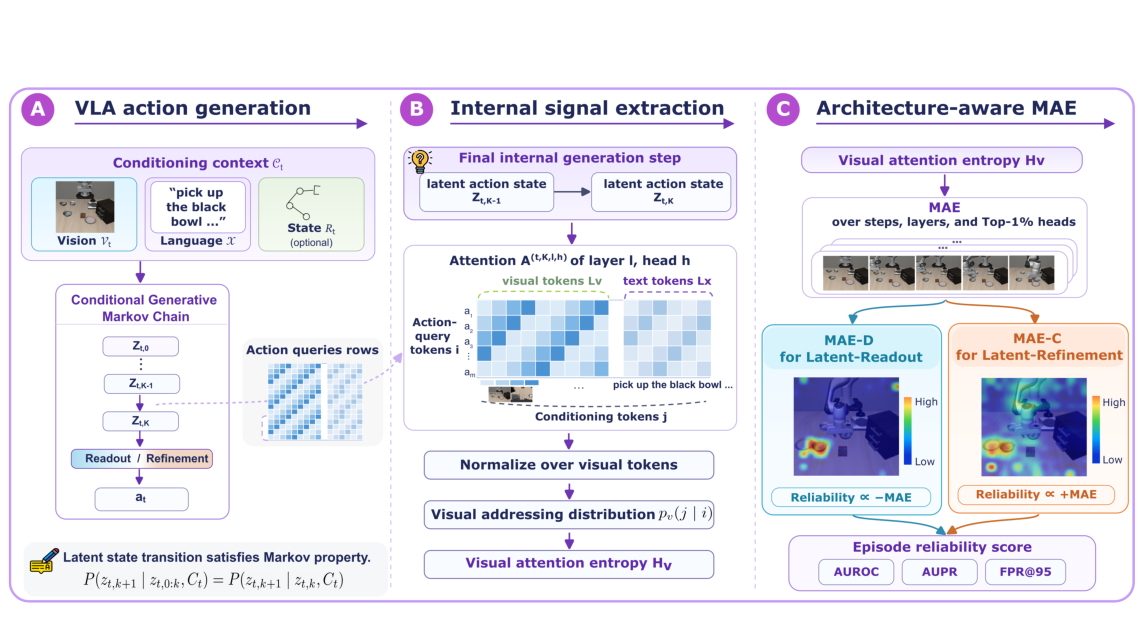
MAE studies whether vision–language–action models can assess their own action generation using internal attention signals. A conditional generative Markov-chain view supplies a common abstraction across latent readout and latent refinement, while the score remains aware of their different computational roles.
That distinction matters: visual concentration associated with reliable readout does not imply that the same entropy orientation is appropriate for iterative refinement. MAE-D and MAE-C use architecture-aware orientations, turning visual addressing into comparable reliability rankings without expert failure labels for score training.
- LIBERO-Reflect episodes
- 4,000
- VLA policies evaluated
- 3
- Readout and refinement
- 2 families
Research question
Output uncertainty provides only a partial view of robotic action generation, especially when policies use different action heads or refinement procedures. Internal signals may contain additional evidence, but a uniform interpretation can erase the architectural differences that give those signals meaning.
Method
- Represent heterogeneous action-generation procedures through a shared conditional latent-transition abstraction.
- Extract visual-attention entropy and use the appropriate orientation for latent-readout or latent-refinement policies.
- Evaluate reliability rankings on LIBERO-Reflect with standard and challenging episodes across several task subsets.
 Enlarge ↗
The framework extracts internal visual addressing and applies the appropriate MAE orientation.
Paper, p. 3Evidence
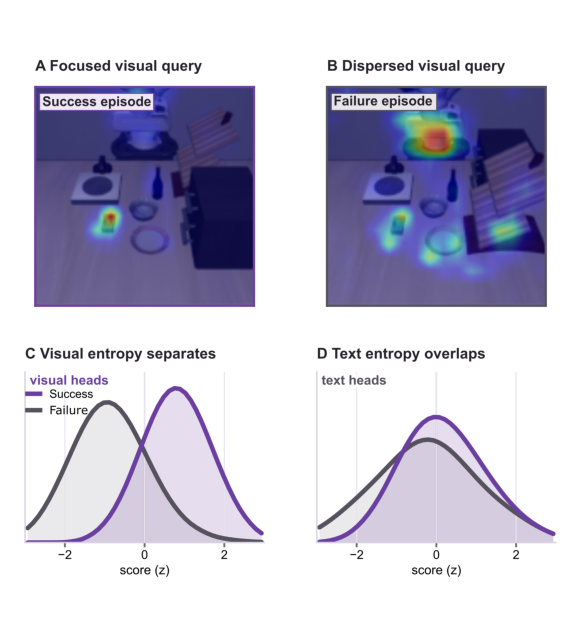
LIBERO-Reflect contains 4,000 episodes, split evenly between standard and challenging conditions. Evaluations cover OpenVLA, OpenVLA-OFT, and QwenPI-Flow and report AUPR, AUROC, and FPR@95. Ablations compare visual and text heads, selection scope, efficiency, and repeated simulator seeds.
 Enlarge ↗
Example attention maps and score distributions compare successful and failed episodes and visual versus text signals.
Paper, p. 2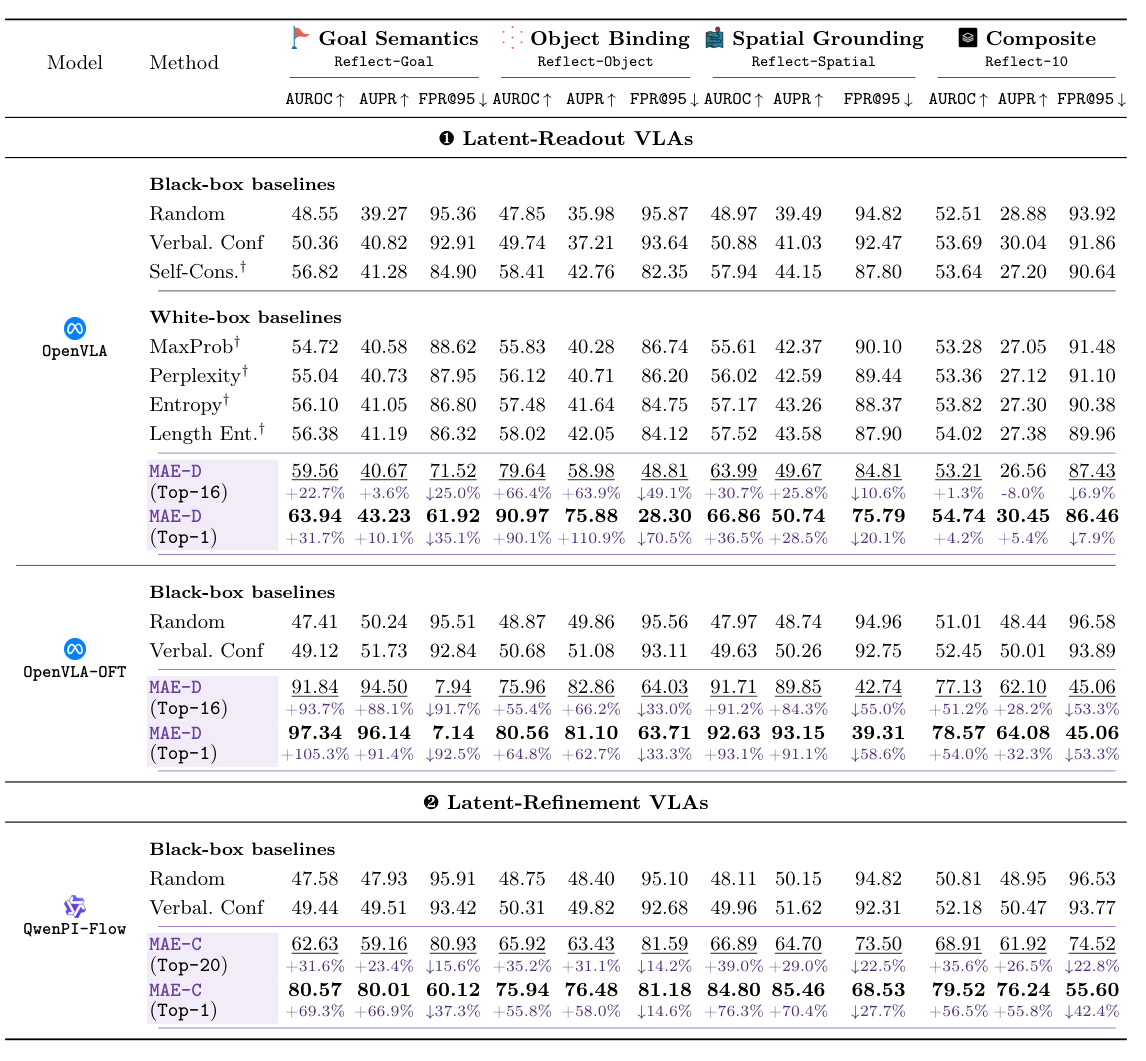 Enlarge ↗
The source table compares evaluation metrics across three policies and the benchmark’s task subsets.
Paper, p. 7Takeaways
The work connects self-evaluation to the structure of the computation being evaluated. Attention entropy becomes useful when its direction and location are matched to the action-generation mechanism; the same numerical tendency can mean different things in different architectures.
This offers a route toward monitoring based on existing internal information. A reliability ranking can inform future decisions about intervention or fallback, while threshold calibration and closed-loop benefits require their own evaluation beyond a successful ranking experiment.
A reliability signal must be interpreted in relation to the computation that produces the action.
Paper and resources
MAE I Trust Myself? Self-Evaluating VLA Action Generation with Markov Attention Entropy
Paper contact · aniri@dbs.ifi.lmu.de