
At a glance
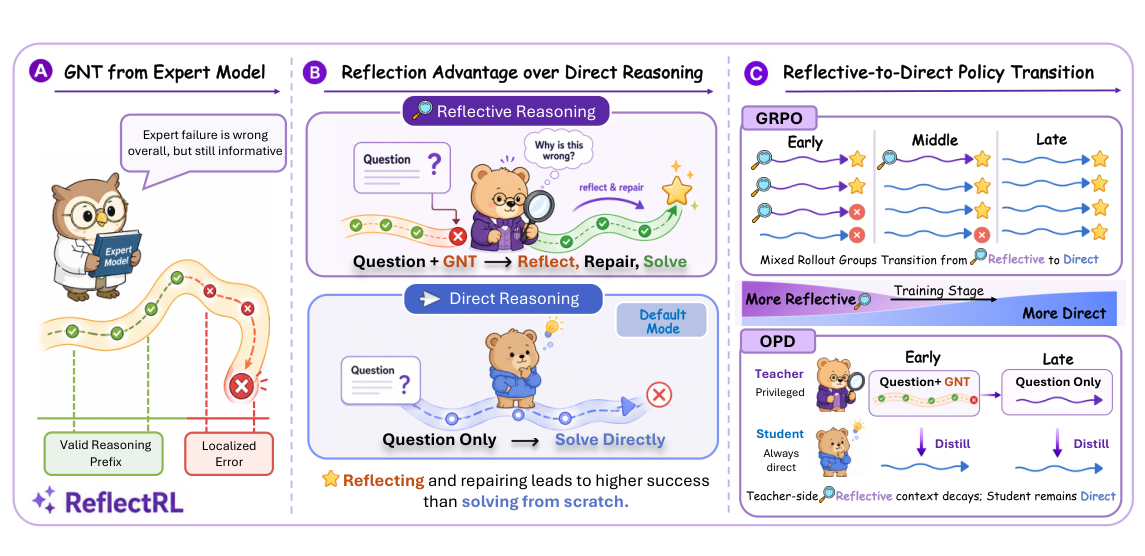
ReflectRL studies expert trajectories that fail on difficult questions. Such trajectories need not be treated as correct demonstrations to contain useful information: they can provide a partially productive route that is easier to inspect and repair than to recreate from scratch. The study calls this setting a Reflection Advantage.
The framework uses these golden negative trajectories to elicit reflective reasoning, then transitions the policy back toward direct reasoning. This separates the information useful during training from the behavior desired when the trained model answers independently.
- Evaluation benchmarks
- 9
- Language-model backbones
- 4
- On-policy training methods
- 4
Research question
Trajectory-guided training loses supervision precisely where expert models also struggle. Discarding every failed attempt can remove intermediate reasoning structure that might still help a learner identify and resolve the difficult part.
Method
- Collect failed expert trajectories as material for reflection rather than as targets to imitate.
- Combine reflective and direct reasoning within on-policy training.
- Apply a reflective-to-direct policy transition so the acquired behavior transfers to answering without trajectory guidance.
 Enlarge ↗
The framework combines golden negative trajectories, reflective reasoning, and a transition back to direct reasoning.
Paper, p. 3Evidence
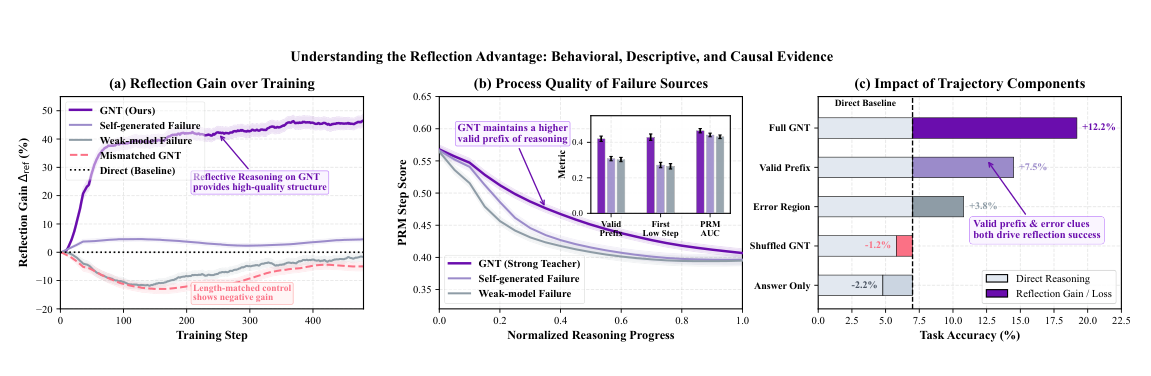
Experiments span nine benchmarks, four language-model backbones, and four on-policy training methods. Behavioral and intervention analyses examine the reflection advantage; training dynamics, ablations, and policy-transition comparisons test how the guidance affects learning and later direct reasoning.
 Enlarge ↗
Behavioral, descriptive, and intervention analyses investigate what information failed trajectories provide.
Paper, p. 2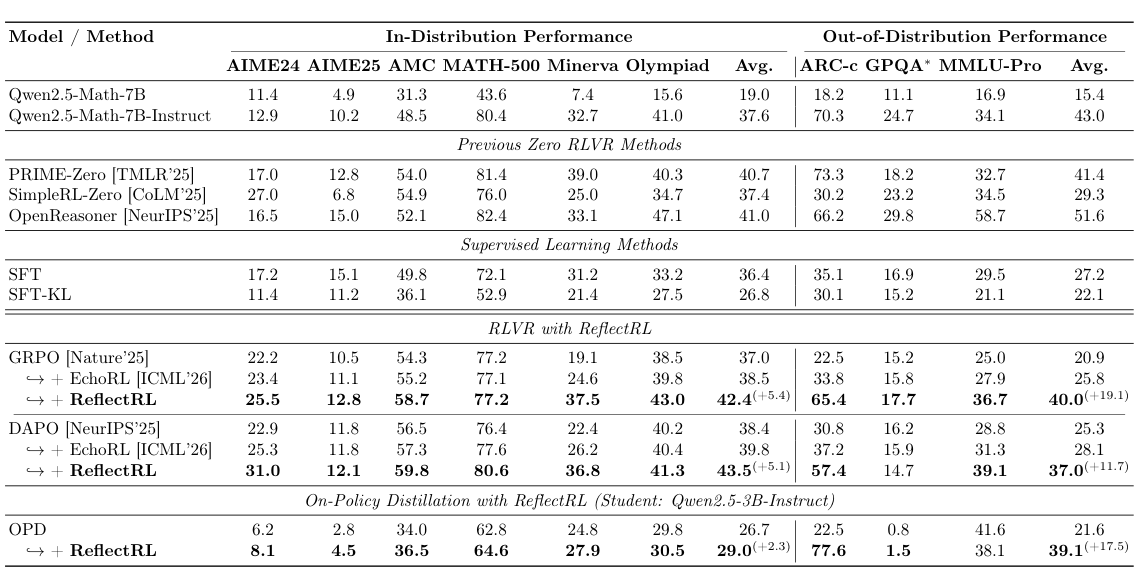 Enlarge ↗
The source table compares training methods with and without ReflectRL on ID and OOD benchmarks.
Paper, p. 6Takeaways
This changes the role of a negative example from a scalar signal of failure to an object with potentially reusable structure. Learning can ask which parts remain informative, where the reasoning breaks, and how a successful continuation differs.
The policy transition addresses a second challenge: supervision should improve the model’s own competence rather than create permanent dependence on privileged context. Studying both stages helps distinguish gains from access to an expert attempt and gains that persist in the model’s independent reasoning.
A failed expert attempt can retain useful structure when the learning objective rewards repairing it.
Paper and resources
ReflectRL: Learning from Golden Negative Trajectories via Reflective-to-Direct Reasoning
Paper contact · bijinhe@outlook.com