
At a glance
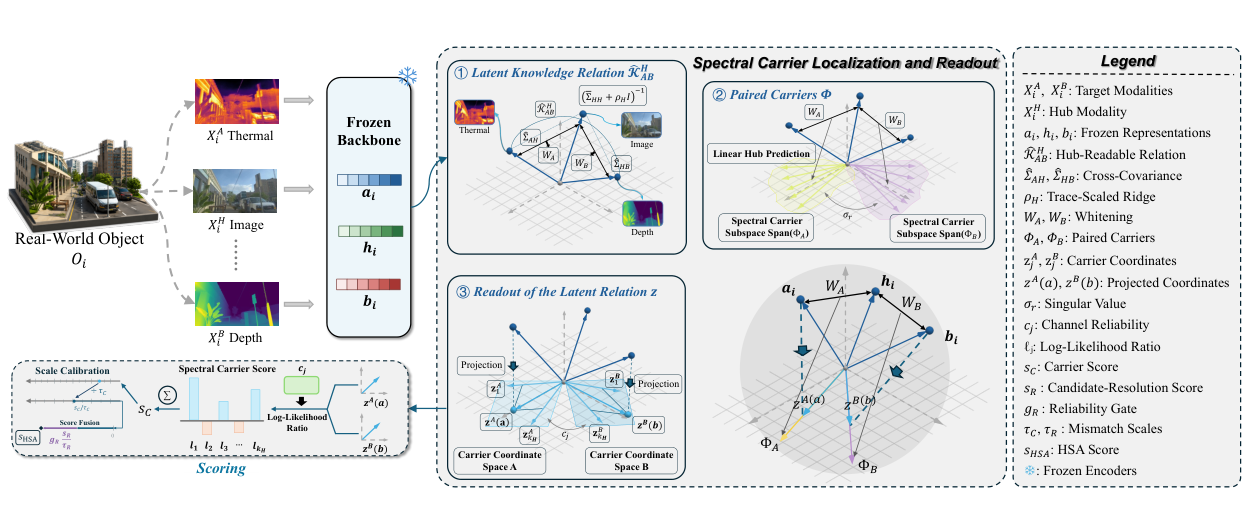
Hub-Spectral Activation studies latent relationships between modalities that share a hub. It builds a second-order view of the two hub-linked edges, identifies paired spectral directions, and uses them to read out a relation between the target modalities. The construction uses frozen representations without direct target-pair supervision.
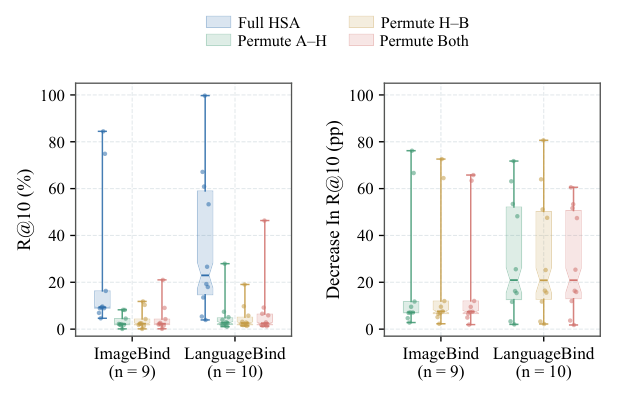
The study tests this readout on retrieval and prototype classification. Permutation controls and source-sample analyses examine whether the improvements depend on meaningful correspondence in the hub edges, connecting performance gains to a concrete structural account.
- Mean bidirectional Recall@10
- 31.15%
- Mean macro Top-1 accuracy
- 52.43%
- Retrieval + classification relations
- 19 + 11
Research question
Training two modalities against a shared hub does not guarantee their mutual alignment. The question is which part of their relation is identifiable from the two trained hub edges.
Method
- Compose and standardize the second-order statistics of the two source-trained hub edges.
- Extract paired spectral directions to represent the hub-readable component.
- Combine reliability-weighted matching and source-gated candidate resolution for retrieval and prototype classification.
 Enlarge ↗
Hub-linked statistics identify paired spectral carriers for a target relation without direct target-pair supervision.
Paper, p. 4Evidence
Across ImageBind and LanguageBind, mean bidirectional Recall@10 rises from 18.27% to 31.15% over 19 relations. Mean macro Top-1 rises from 29.01% to 52.43% over 11 prototype-classification relations.
 Enlarge ↗
Permuting hub-edge correspondences tests the structural information that supports the readout.
Paper, p. 9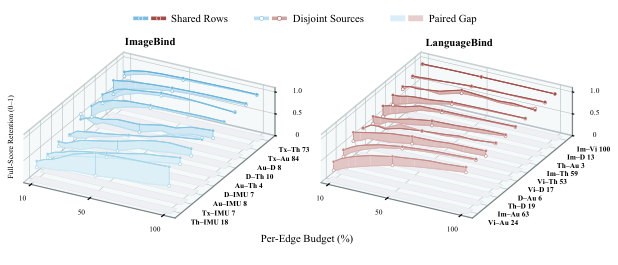 Enlarge ↗
Shared-row and disjoint-source estimates are compared as the source-sample budget changes.
Paper, p. 10Takeaways
The central implication is a distinction between the information a model contains and the interface used to access it. Weak performance under frozen cosine similarity can reflect a limited readout of the available relational structure. Studying that interface can reveal capability that additional backbone training is not required to create in the tested setting.
Recoverability still depends on the hub and the statistical structure available in its two edges. The paper’s controls help define those conditions, suggesting a research program around when shared coordinates support useful cross-modal composition and when they do not.
What a representation can express may exceed what its default similarity interface can reveal.
Paper and resources
Hub-Spectral Activation of Latent Multimodal Knowledge
Paper contact · guoying@ncut.edu.cn