
At a glance
Transport and Merge uses optimal transport over activation relationships to establish correspondences between heterogeneous language models. These correspondences guide layer and feature alignment, making cross-architecture weight fusion possible. A small shared input set supplies the evidence needed to connect the two models.
The work evaluates knowledge transfer in low-resource language and domain settings, and explores residual-frozen adaptation after fusion. It separates the problem of finding a functional correspondence from the subsequent problem of integrating the transferred representation.
- Cross-neuron correspondence
- OT
- Heterogeneous model fusion
- Cross
- Shared-input alignment set
- Small
Research question
Conventional merging often assumes compatible architectures. That assumption limits transfer from high-resource source models to heterogeneous targets with limited task or language data.
Method
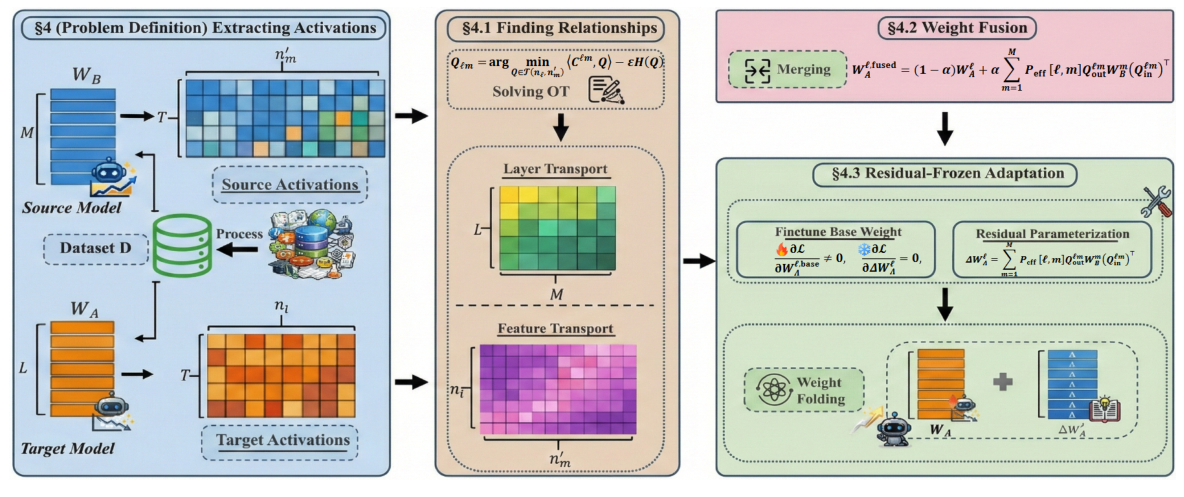
- Collect activations from source and target models on a small set of shared inputs.
- Solve optimal transport to establish correspondences between heterogeneous neuronal representations.
- Use the resulting transport plans to guide direct weight-space fusion.
 Enlarge ↗
Activation correspondences guide layer transport, feature transport, and weight fusion.
Paper, p. 4Evidence
Experiments across low-resource languages and specialized domains report consistent improvements over the corresponding target models. The transfer uses a small input set to infer the cross-model correspondence.
 Enlarge ↗
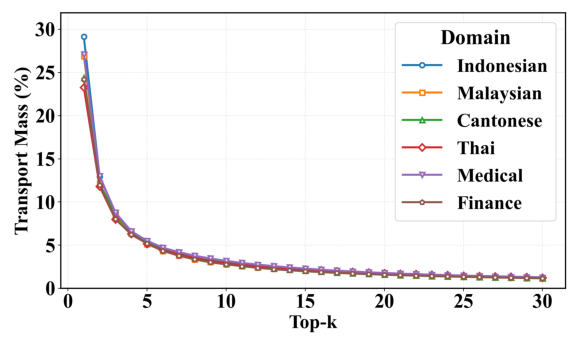
The plot measures the transport mass explained by the leading neuron correspondences.
Paper, p. 8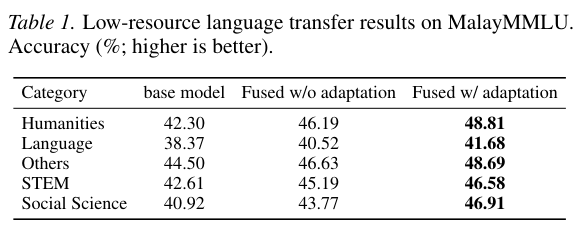 Enlarge ↗
The original MalayMMLU table compares the base model with fusion and subsequent adaptation.
Paper, p. 6Takeaways
This frames model merging as a problem of translation between internal coordinate systems. Architecture can obscure correspondence even when two models contain related computations; activation relationships provide an empirical bridge across that boundary.
The useful outcome is reusable knowledge under limited adaptation data. Future progress depends on identifying when transport plans preserve function, how shared-input coverage affects the mapping, and whether gains survive beyond the domains that supplied the correspondence evidence.
Transferring knowledge across architectures begins with finding which internal computations correspond.
Paper and resources
Transport and Merge: Cross-Architecture Merging for Large Language Models
Paper contact · chenhangcui@gmail.com