
At a glance
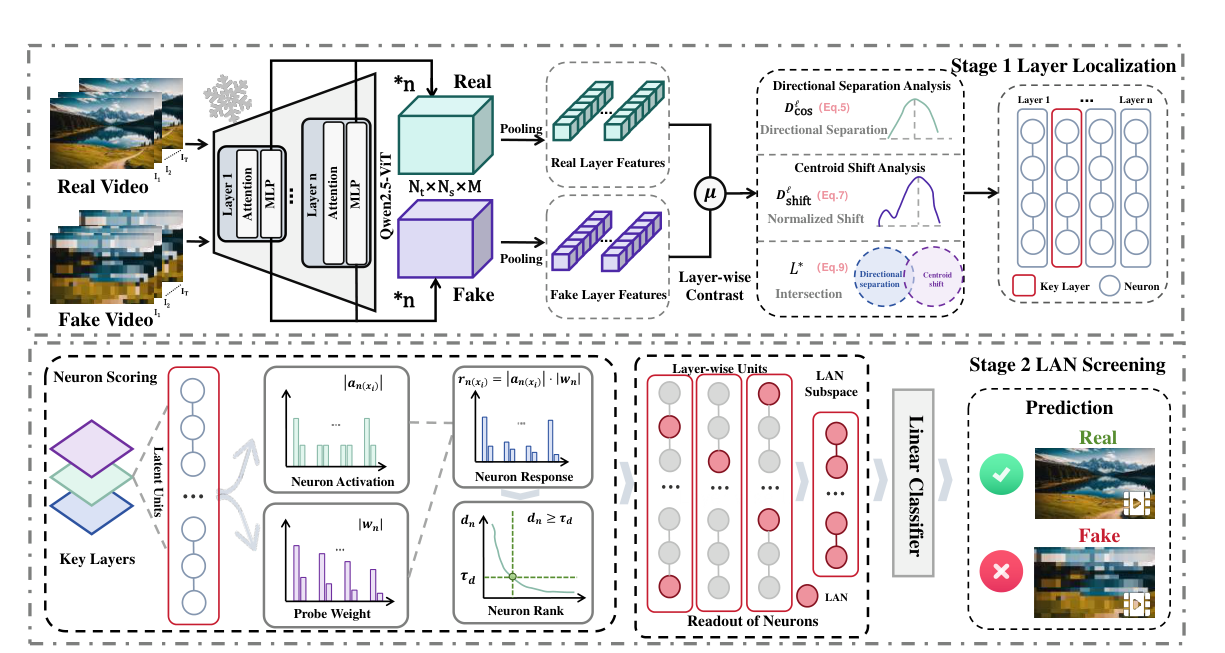
V-FIND asks how much forensic capability can be recovered from a video detector without retraining its backbone. It locates layers that separate authentic and synthetic videos, then identifies sparse latent anchor neurons carrying consistent discriminative signals. These coordinates form a compact forensic subspace.
A lightweight linear classifier reads the selected subspace while the original backbone remains frozen. External benchmarks and neuron interventions test whether those signals are reusable and functionally relevant, connecting internal localization to observable detection behavior.
- Original video backbone
- Frozen
- Compact-subspace readout
- Linear
- Functional neuron analysis
- Swap tests
Research question
Optimizing a detector as a black box reveals little about which of its learned signals support generalization. Sparse internal localization offers a way to examine the knowledge already present before allocating the cost of further full-model adaptation.
Method
- Locate critical layers using complementary discrepancies between real and forged video representations.
- Select latent anchor neurons from the localized layers and assemble a compact subspace.
- Train a linear readout with the backbone frozen, then test external generalization and targeted neuron interventions.
 Enlarge ↗
Layer localization and latent-anchor selection precede linear classification from a frozen backbone.
Paper, p. 3Evidence
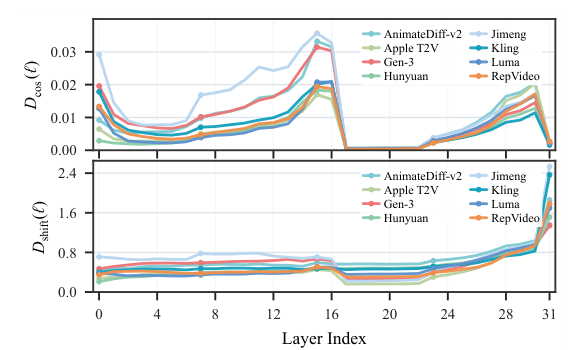
The selected results show layer-localization signals and detection comparisons on external generated-video benchmarks. The study also uses fixed-budget controls, depth restrictions, cross-architecture checks, and paired activation swaps to examine whether the selected units contribute beyond a favorable feature budget.
 Enlarge ↗
The two discrepancy signals vary with depth across eight fake-source subsets.
Paper, p. 3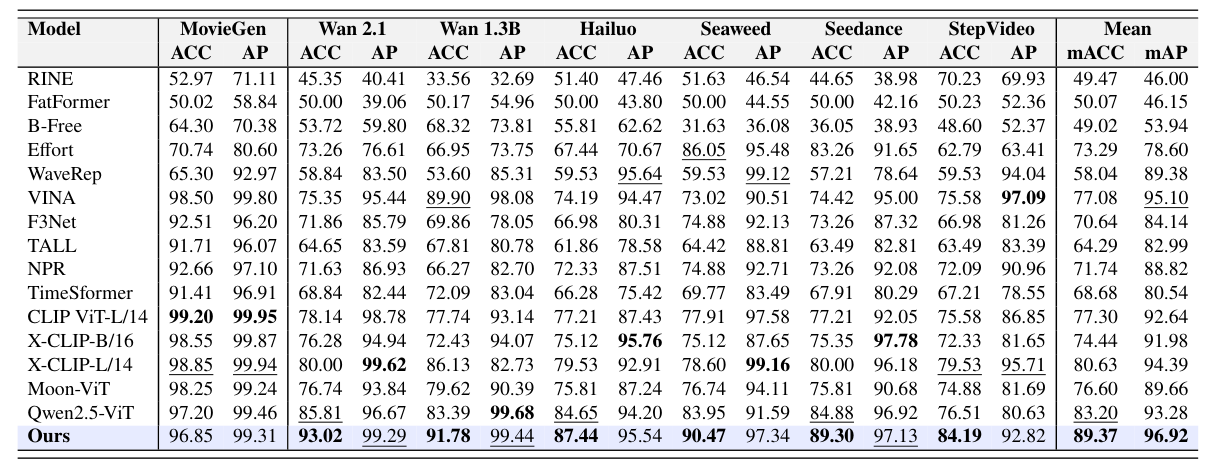 Enlarge ↗
The original table compares accuracy and average precision on external generated-video datasets.
Paper, p. 4Takeaways
The work turns a trained detector into a source of inspectable and potentially reusable knowledge. A successful sparse readout helps separate the capacity stored in a representation from the particular classifier that originally exposed it.
Generalization still depends on which distinctions those coordinates capture. External-generator tests and activation swaps make that question more concrete: they examine both where the signal transfers and how changing the selected representation changes the decision.
A detector’s useful forensic knowledge can be studied as an internal representation that survives a new readout.
Paper and resources
V-FIND: Revealing the Intrinsic Forgery Knowledge Encoded in Video Forgery Detectors
Paper contact · kanshichao@csu.edu.cn