
At a glance
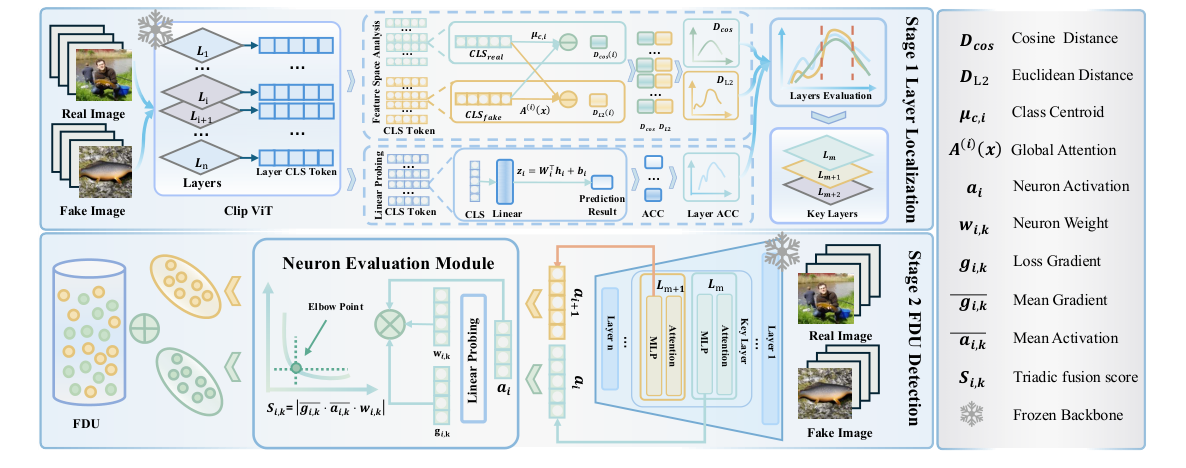
DNA searches a frozen visual backbone for forgery-discriminative units through a coarse-to-fine procedure. Layer-level geometry narrows the search, while a triadic score and curvature-based selection identify sparse units. A lightweight detector then uses those units to distinguish authentic and synthetic images.
The HIFI-Gen evaluation examines transfer to generators and architectures outside training. This places the emphasis on whether selected representations carry reusable forensic information, beyond the signatures of the generators used to build the detector.
- Forgery-discriminative units
- FDUs
- Limited-supervision detection
- Few-shot
- High-fidelity generation benchmark
- HIFI-Gen
Research question
Task-level adaptation can conceal which pretrained components already carry forensic information. The study asks whether a compact set of such components can serve as a detection basis.
Method
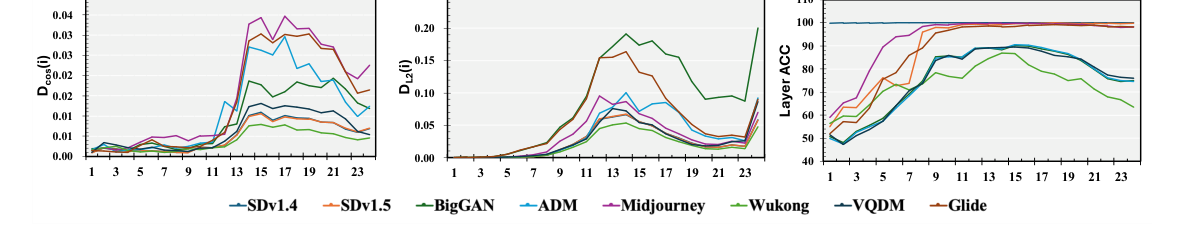
- Analyze feature decoupling and attention shifts to locate critical intermediate layers.
- Combine triadic scoring with curvature truncation to select forgery-discriminative units.
- Evaluate selected anchors on forgery benchmarks, including the introduced HIFI-Gen dataset.
 Enlarge ↗
Layer localization and discriminative-unit selection extract a compact interface from the frozen backbone.
Paper, p. 4Evidence
The paper reports strong few-shot detection and robustness across evaluated architectures and unseen generators. Its experiments examine the usefulness of the selected anchors under distribution changes.
 Enlarge ↗
Layer-wise distances between authentic and synthetic distributions inform localization.
Paper, p. 4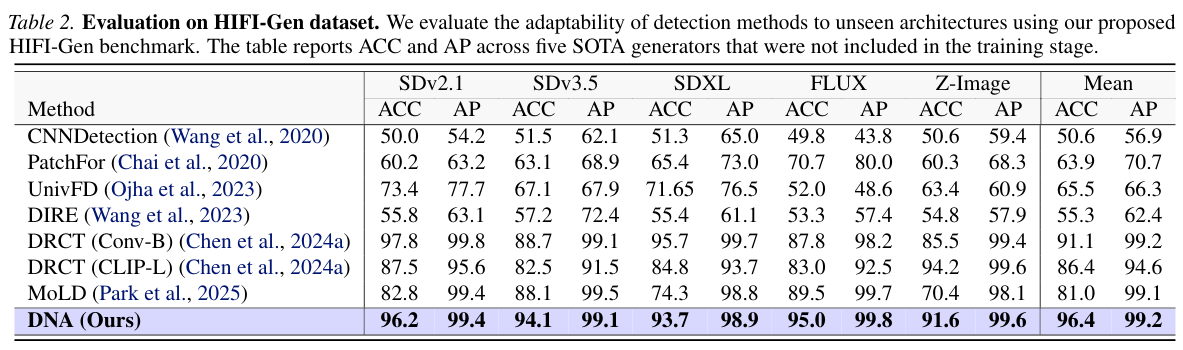 Enlarge ↗
The table tests detection on generator architectures outside the training stage.
Paper, p. 6Takeaways
The key question in forensics is what survives the next change in generation technology. Internal localization offers a way to investigate that question at the representation level, by examining which discriminative coordinates remain informative when the source of synthetic images changes.
The work suggests a path from pretrained knowledge to a compact, inspectable detection interface. Generalization remains an empirical claim tied to the tested shifts; broader deployment calls for continued evaluation on new generators, processing pipelines, and authentic-image distributions.
Generalizable forgery detection can begin with discriminative structure already present in pretrained features.
Paper and resources
DNA: Uncovering Universal Latent Forgery Knowledge
Paper contact · jdou0056@uni.sydney.edu.au