
At a glance
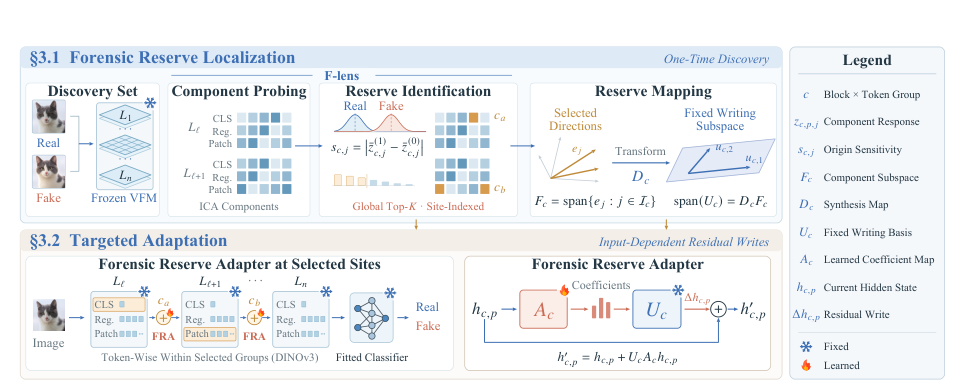
Forensic Reserve studies the forensic signals already present in frozen visual encoders. F-Lens localizes sparse components that distinguish real from generated images, while Reserve-Guided Elicitation adapts constrained subspaces at the selected sites. The model’s internal structure determines where adaptation is allowed to act.
This turns interpretability into an adaptation strategy. Instead of treating every feature and layer as equally useful, the method concentrates its limited examples and trainable parameters on identified forensic reserves. Cross-backbone experiments test whether that strategy transfers beyond a single encoder.
- Labelled training images
- 500
- Trainable parameter budget
- <0.2%
- Pretrained encoders
- 8
Research question
A pretrained representation may already contain useful forensic signals that ordinary task adaptation does not specifically exploit. Identifying where those signals reside can guide which components should be adapted.
Method
- Use F-lens to decompose activations and screen components by real-versus-generated response differences.
- Map selected directions back to hidden-state space and place Forensic Reserve Adapters at identified sites.
- Train only coefficient maps; keep the backbone, fitted reference classifier, and subspace bases fixed.
 Enlarge ↗
F-Lens finds forensic reserves and FRA adapts the constrained subspaces at selected sites.
Paper, p. 3Evidence
With 500 labelled images and fewer than 0.2% trainable backbone parameters, RGE is evaluated on three benchmarks without target-benchmark adaptation. Improvements over corresponding frozen detectors hold across eight encoders.
 Enlarge ↗
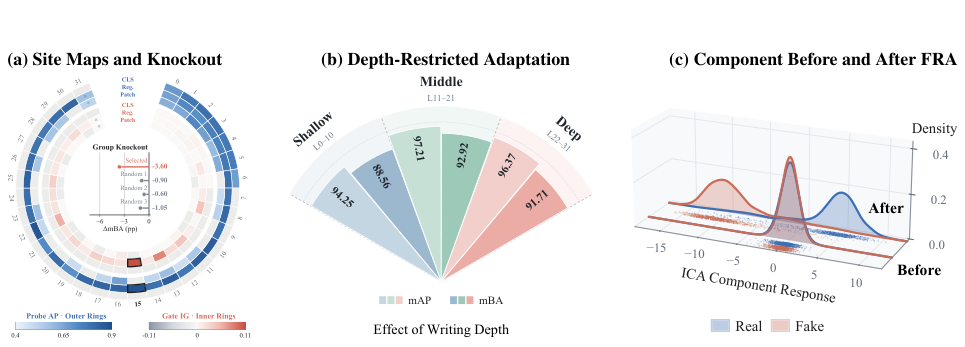
Site maps, depth-restricted adaptation, and component responses examine the structure and use of forensic reserves.
Paper, p. 7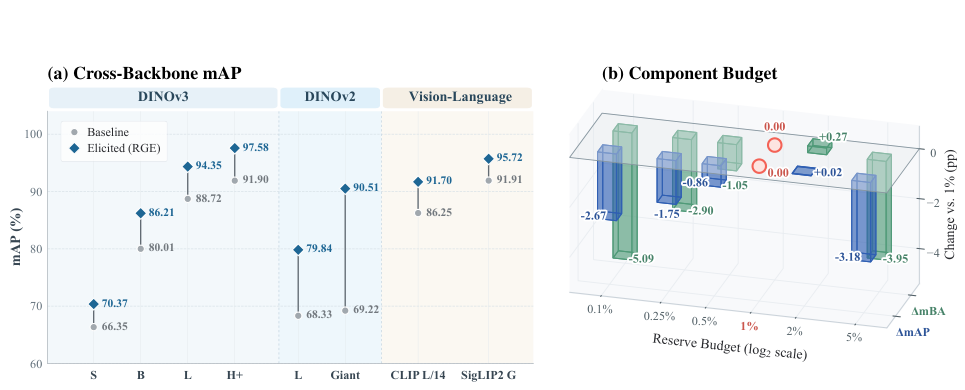 Enlarge ↗
The plots relate detection performance to backbone choice and the budget of reserve components.
Paper, p. 9Takeaways
The result suggests a concrete connection between understanding a representation and using data efficiently. Locating a task-relevant subspace can reduce the degrees of freedom that must be fitted, helping adaptation exploit existing discrimination rather than reconstruct it from a small dataset.
For forensics, the central test remains robustness to unfamiliar generators and distribution changes. Reserve localization offers a mechanism for studying that robustness: which signals are reused, how adaptation changes them, and when those signals stop separating authentic and synthetic content.
Efficient adaptation starts by locating the task-relevant capacity a pretrained model already contains.
Paper and resources
Forensic Reserve: Eliciting Latent Knowledge for Image Forgery Detection
Paper contact · jiahua.li@ndph.ox.ac.uk