
At a glance
Beyond Surface Artifacts studies forgery detection across modalities rather than only across generators within one medium. Its MAF framework uses modality-specific perceptors and a shared lightweight detector, with regularization intended to reduce dependence on modality-specific style and encourage forensic alignment.
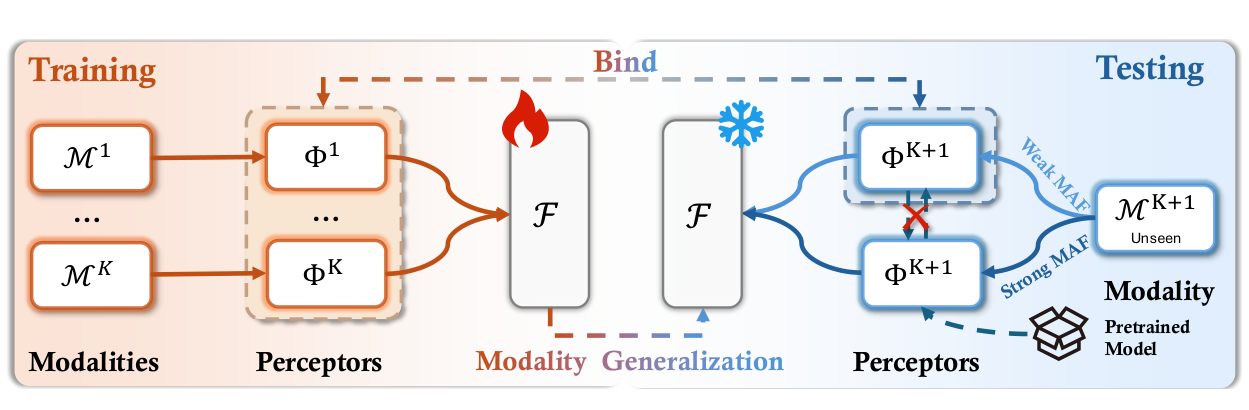
Two evaluation settings separate different transfer conditions. Weak MAF uses semantically aligned perceptors; Strong MAF uses an independently learned perceptor for an unseen modality. In the latter setting, target-modality data can support self-supervised representation learning while the forgery detector itself remains fixed.
- Video, audio, and image
- 3 media
- Two transfer conditions
- Weak / Strong
- Modality-agnostic detection
- Shared head
Research question
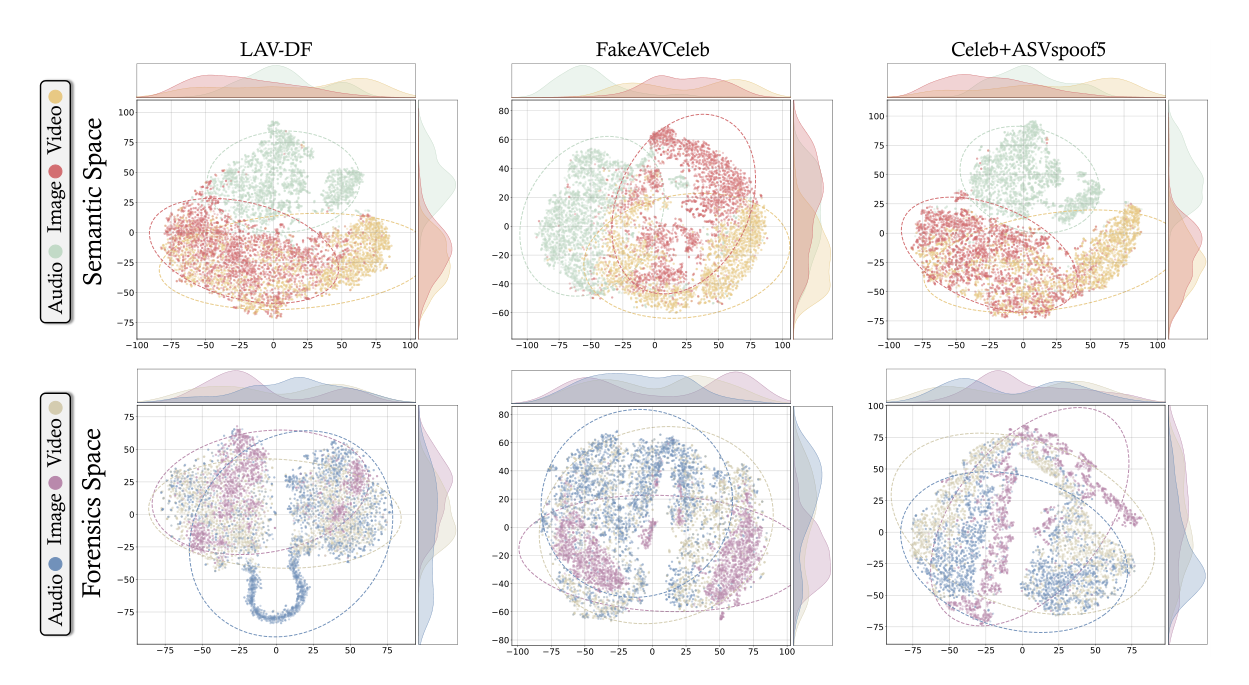
A representation aligned for semantics need not align the distinctions relevant to forensics. A detector can therefore appear broadly capable while depending on artifacts tied to the media it has already seen.
Method
- Encode source modalities with their perceptors and train a shared lightweight forgery detector.
- Combine classification with cross-modal regularization to encourage transferable forensic representations.
- Evaluate unseen modalities under Weak and Strong MAF, explicitly distinguishing the target perceptor and data assumptions.
 Enlarge ↗
Weak and Strong MAF expose different assumptions about the representation of an unseen modality.
Paper, p. 3Evidence
DeepModal-Bench compares cross-modality generalization across video, audio, and image settings. The selected figures contrast semantic and forensic feature distributions and report Strong MAF performance across several pretrained perceptors. Further analyses inspect distribution consistency and cross-modal neuron co-activation.
 Enlarge ↗
The original visualizations compare modality structure in semantic and forensic feature spaces.
Paper, p. 4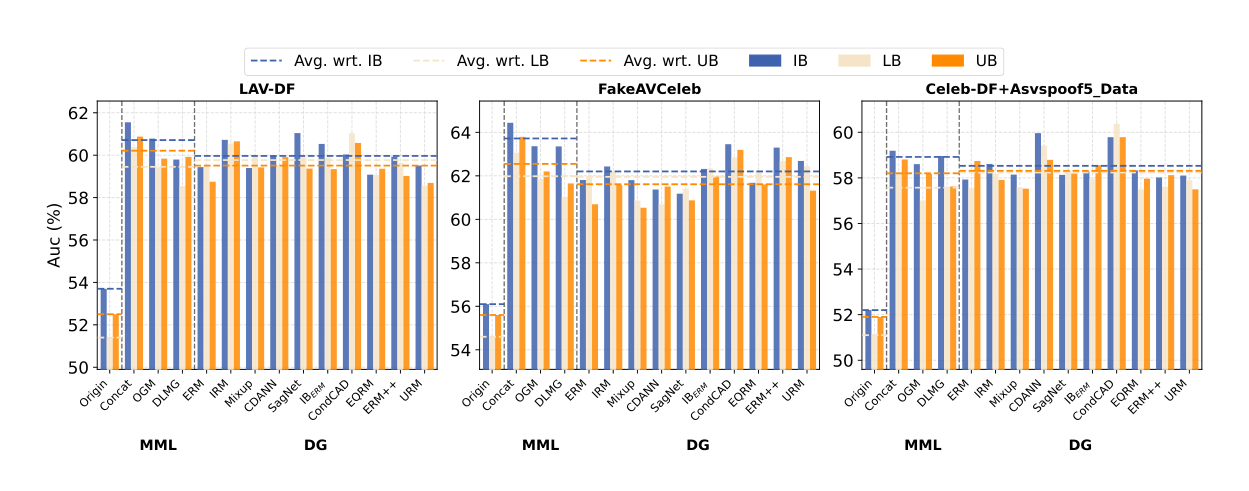 Enlarge ↗
The bars compare detection accuracy in Strong MAF across several perceptors and benchmarks.
Paper, p. 7Takeaways
This work broadens the unit of generalization from a new generator to a new kind of signal. It invites a more demanding question about detection: which learned distinctions reflect the task, and which merely reflect the medium through which the task was observed?
The two settings make the assumptions of that question visible. Performance with an aligned perceptor and performance with an independently learned target representation support different conclusions. Keeping those conditions explicit is essential when assessing how much forensic knowledge genuinely transfers.
Forensic transfer asks what remains informative when the physical medium and its familiar artifacts change.
Paper and resources
Beyond Surface Artifacts: Capturing Shared Latent Forgery Knowledge Across Modalities
Paper contact · jdou0056@uni.sydney.edu.au