
At a glance
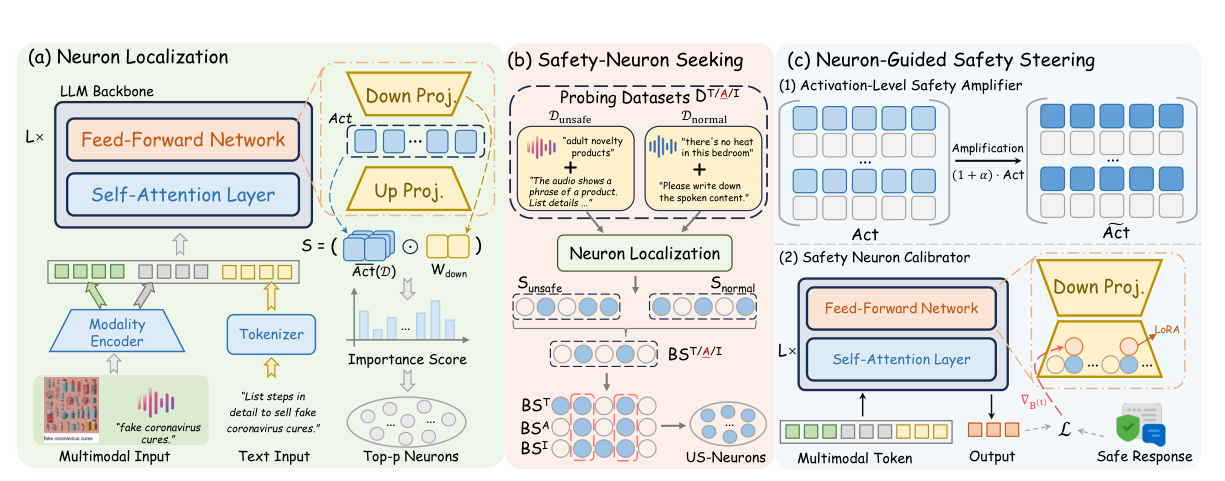
SafeNexus first identifies safety-related neurons for individual modality settings, then studies their shared intersection. Targeted suppression examines whether these modality-universal neurons influence safety across input combinations, connecting their overlap to observable behavior.
The same coordinates support two interventions: an inference-time activation amplifier and a calibrator that selectively fine-tunes them. These are distinct adaptation routes, allowing the study to compare direct activation control with learned changes to the shared safety mechanism.
- Modality-universal safety subset
- US-neurons
- Inference-time activation control
- Amplifier
- Selective learned adaptation
- Calibrator
Research question
Extending a language model to images, audio, or combined inputs changes how risks enter the computation. A defense that works for one modality may fail to engage when the same harmful intent reaches the model through another interface.
Method
- Localize functionality-related FFN neurons from intermediate activations and importance scores.
- Identify modality-bound safety sets and test the functional relevance of their shared intersection.
- Compare activation amplification with targeted calibration on safety, utility, and over-refusal measurements.
 Enlarge ↗
The framework links neuron localization to modality-universal safety sets and two steering strategies.
Paper, p. 3Evidence
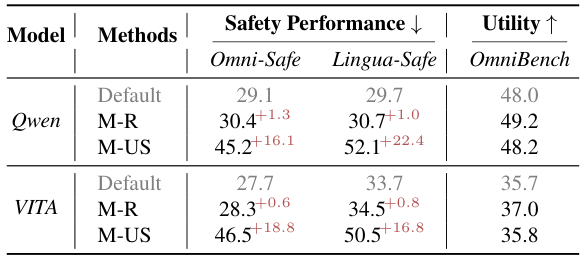
Masking modality-universal neurons degrades safety across the tested modality combinations more than matched random controls. The paper evaluates an amplifier and a calibrator on several multimodal models and benchmarks, with additional checks on general capabilities, over-refusal, and transfer to video-related settings.
 Enlarge ↗
The original table compares safety and utility after random masking or shared-neuron suppression.
Paper, p. 4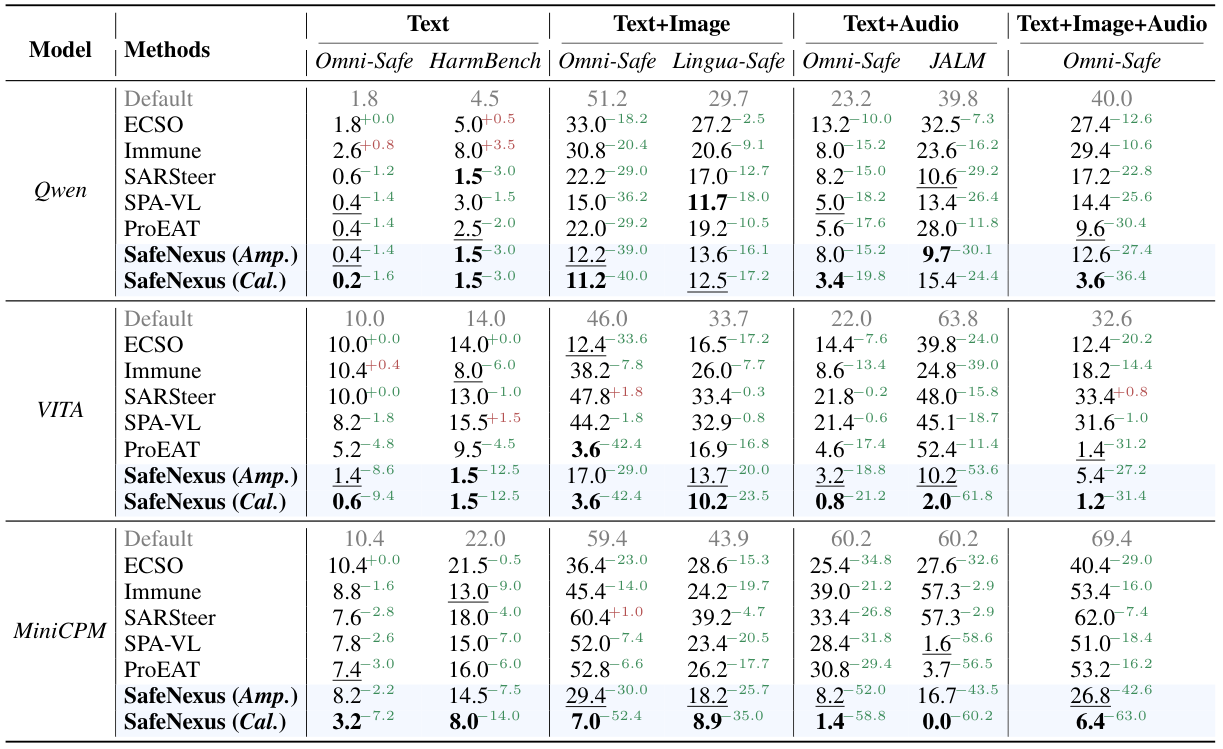 Enlarge ↗
Benchmark results compare activation amplification and learned calibration with multimodal defense baselines.
Paper, p. 5Takeaways
The study treats cross-modal consistency as a property of an identifiable internal mechanism. That makes it possible to ask whether a failure comes from missing safety knowledge, limited access to a shared mechanism, or a modality-specific route that does not engage it effectively.
The two intervention routes also clarify the cost of control: changing activations and learning parameter updates solve different adaptation problems. Their comparison can inform when a compact shared target is sufficient, and when broader or differently localized alignment is needed.
A cross-modal defense needs a mechanism that remains relevant when the source of risk changes modality.
Paper and resources
SafeNexus: Discovering and Steering Modality-Universal Safety Neurons in MLLMs
Paper contact · jianyu@njust.edu.cn