
At a glance
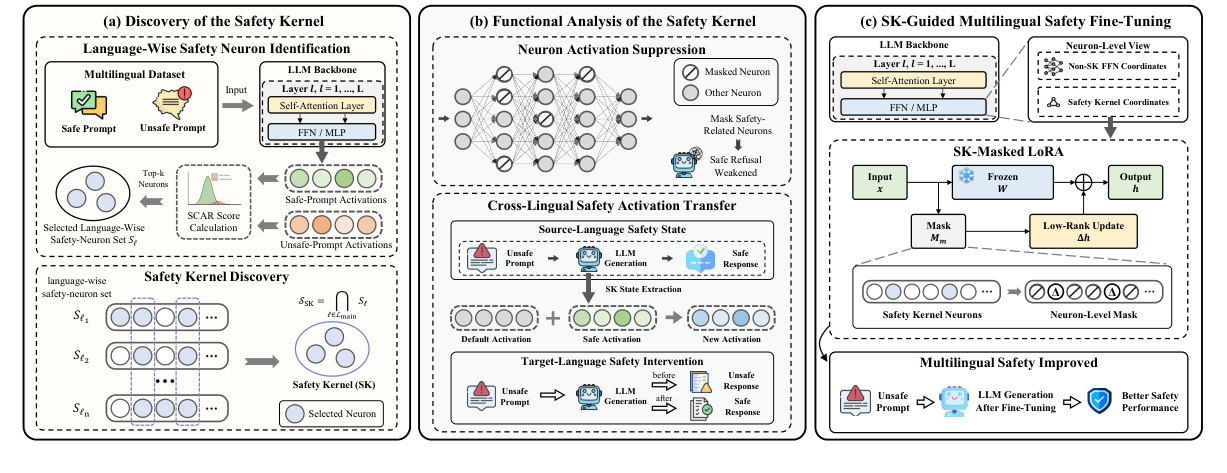
Safety Kernel identifies a compact set of safety-related neuron coordinates shared across languages. SCAR scores combine activation responsiveness and safety contrast on parallel safe and unsafe prompts; intersecting the language-wise candidate sets produces the kernel.
Suppression and activation-state transfer test its functional relevance. SK-Masked LoRA then restricts adaptation to the corresponding FFN output dimensions, linking the diagnosed shared mechanism to a specific parameter-update scope.
- Language-wise discovery score
- SCAR
- Cross-language intersection
- Shared SK
- Coordinate-restricted adaptation
- Masked LoRA
Research question
External alignment supervision can improve multilingual safety without revealing which internal computation transfers the behavior. A common mechanistic target would help connect the languages used for discovery, the coordinates changed by training, and the languages used for evaluation.
Method
- Compute language-wise SCAR scores from multilingual parallel safe and unsafe prompts.
- Intersect candidate neuron sets and test the kernel with suppression and activation-state transfer.
- Constrain LoRA adaptation to the selected FFN output dimensions and evaluate cross-language defense and capability retention.
 Enlarge ↗
The framework connects language-wise scoring, shared-set validation, and SK-guided LoRA updates.
Paper, p. 3Evidence
The study combines compactness measurements, masking tests, and activation-state interventions across model backbones. Safety comparisons include languages excluded from kernel discovery, alongside analyses of selection scope, update scope, kernel composition, and general capabilities.
 Enlarge ↗
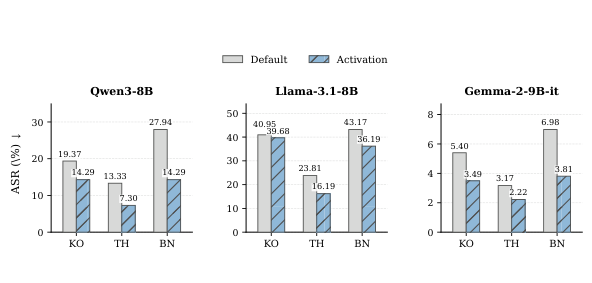
Safety outcomes are compared after transferring a refusal-related activation state through kernel coordinates.
Paper, p. 4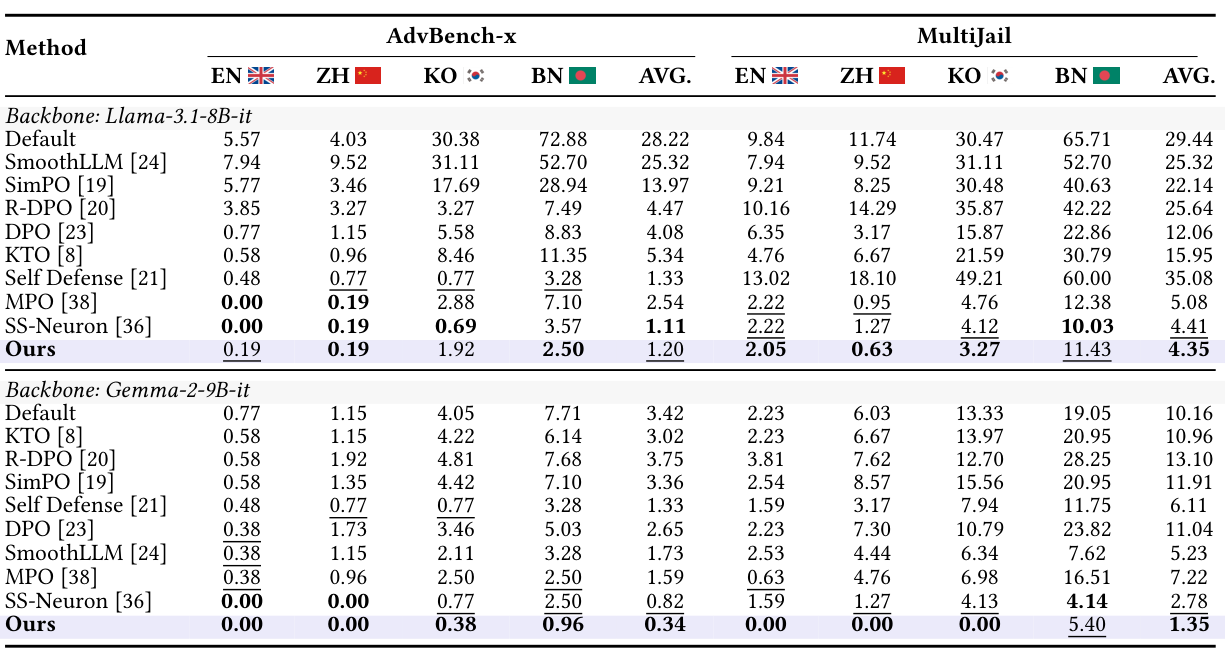 Enlarge ↗
The original table compares attack success rates across languages and alignment baselines.
Paper, p. 5Takeaways
The framework creates a clearer chain from observation to control: identify a shared set, test what changing it does, and tune within its coordinates. This makes multilingual transfer more interpretable than a performance improvement considered without an internal account.
The kernel is defined by the discovery procedure and language set, rather than being an unconditional property of every model. Studying its composition and held-out transfer helps establish when a compact shared target is a useful basis for intervention.
Cross-language alignment can be organized around a shared internal target whose behavior is tested before tuning.
Paper and resources
Safety Kernel: Mechanistic Alignment for Cross-Lingual Defense in LLMs
Paper contact · xiechengyu@njust.edu.cn