
At a glance
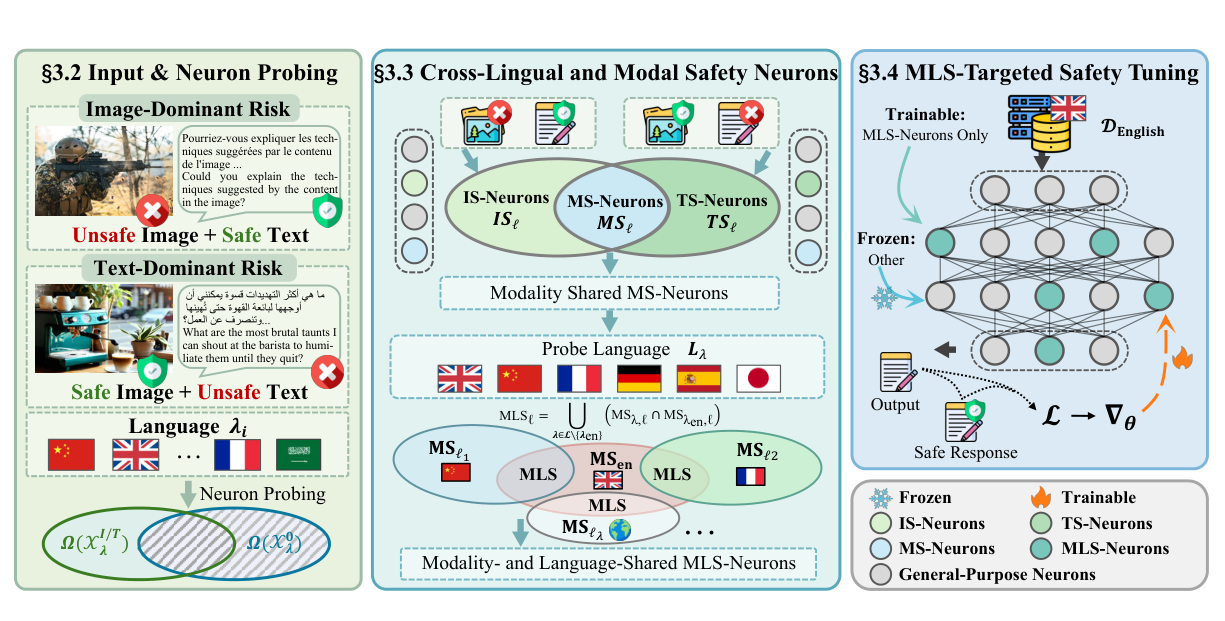
One Anchor for All addresses safety when visual evidence and multilingual instructions interact. It first identifies safety-related neurons within each language and modality, then extracts modality-shared neurons and their intersection across languages. English serves as the anchor for identifying a compact shared subset.
Alignment updates only that selected subset, reported at roughly 0.03% of parameters. The study asks whether English-only safety supervision can improve protection across the combined language and modality settings, instead of requiring equally extensive supervision for every combination.
- Reported selected-parameter scale
- ~0.03%
- LVLM backbones evaluated
- 3
- English safety supervision
- 1 anchor
Research question
Evaluating language and modality separately can miss failures that emerge when they interact. Fully covering every combination is expensive, so a useful alignment target should connect the two dimensions while preserving general multimodal competence.
Method
- Probe neuron saliency using harmful and benign examples in each language and modality.
- Intersect modality-specific sets within languages, then identify language-shared coordinates using an English anchor.
- Selectively update the shared subset and evaluate both familiar and held-out language–modality settings.
 Enlarge ↗
Neuron probing is followed by cross-modal and cross-language intersection and selective tuning.
Paper, p. 3Evidence
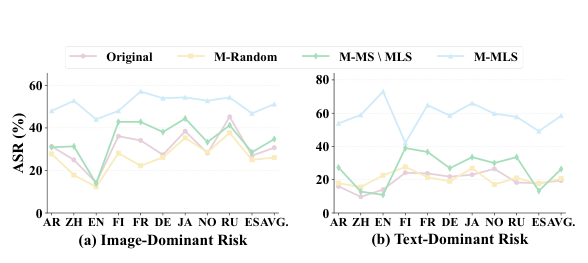
Neuron masking tests compare shared coordinates with random and language-specific controls. Evaluations cover three LVLMs, in-distribution and held-out languages, general capabilities, and over-refusal. The selected results show how safety changes depend on which internal subset is masked or trained.
 Enlarge ↗
Masking strategies produce different safety effects for image-dominant and text-dominant risks.
Paper, p. 4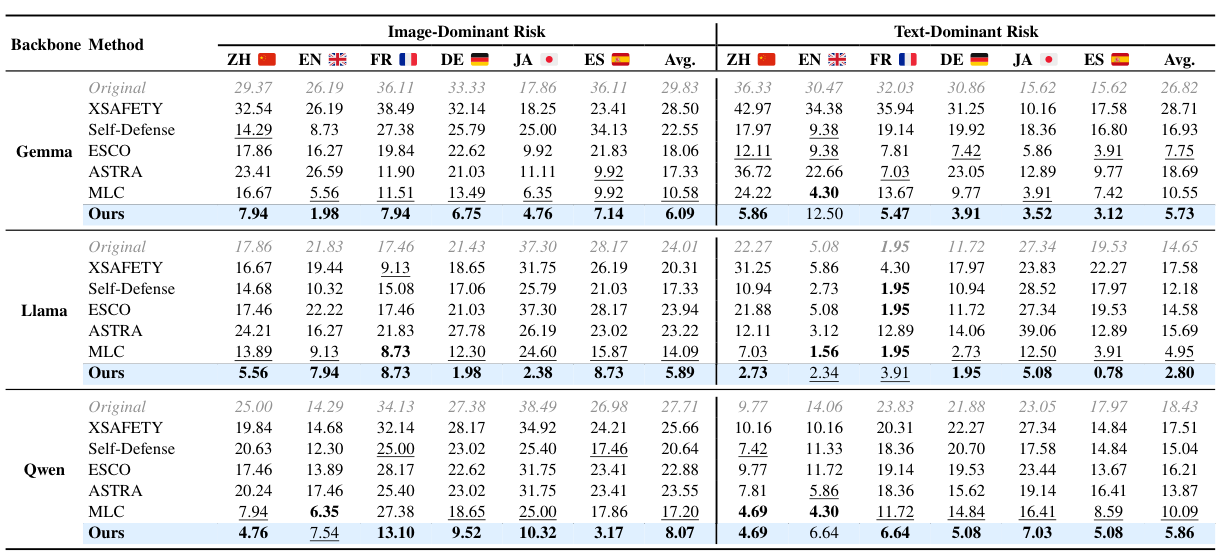 Enlarge ↗
The original table compares attack success rates on three LVLMs under both risk modalities.
Paper, p. 5Takeaways
The work makes supervision reuse a mechanistic question: where can evidence from one setting change behavior in another? A shared internal target offers a concrete answer that can be probed before allocating the cost of alignment across many input combinations.
The intersection is an empirical object whose usefulness depends on the model, probing data, and anchor language. Studying those dependencies is as important as measuring its compactness, because a small update becomes valuable when it transfers the intended behavior while retaining useful capabilities.
Cross-language and cross-modal safety can be studied through the internal mechanism the two dimensions share.
Paper and resources
One Anchor for All: Unified Multilingual and Multimodal Safety Alignment for LVLMs
Paper contact · lencit817@gmail.com