
At a glance
Lingua-SafetyBench contains 100,440 harmful image–text pairs across ten languages. It explicitly separates image-dominant from text-dominant risks, so evaluation can examine which channel carries the harmful intent instead of conflating all multimodal inputs.
This design reveals an asymmetric safety landscape: high-resource languages and non-high-resource languages do not share the same pattern of vulnerability across risk modalities. Analyses of model scaling and iteration further ask whether average improvements benefit all language groups equally.
- Harmful image–text pairs
- 100,440
- Languages covered
- 10
- Image- and text-dominant
- 2 risk modes
Research question
Text-only multilingual tests and monolingual multimodal tests leave a gap at their intersection. Image rendering alone also cannot capture the range of semantic interactions between a visual input and an instruction in another language.
Method
- Construct image–text safety examples with an explicit distinction between image-dominant and text-dominant risks.
- Extend the examples across ten languages and evaluate models under a consistent multilingual protocol.
- Disaggregate attack success rates by language, risk modality, safety category, and model scale or iteration.
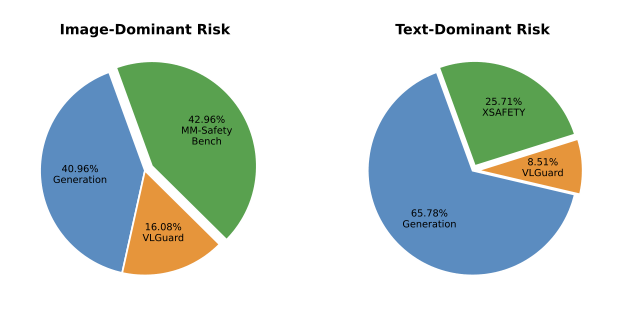 Enlarge ↗
The source distributions are shown separately for image-dominant and text-dominant risks.
Paper, p. 5Evidence
The benchmark analysis includes eleven readily deployable VLLMs and controlled comparisons within the Qwen family. Reported results show substantial variation across languages and an interaction between language-resource level and the dominant risk modality. Scaling improves average safety while leaving uneven gains, particularly for text-dominant non-high-resource settings.
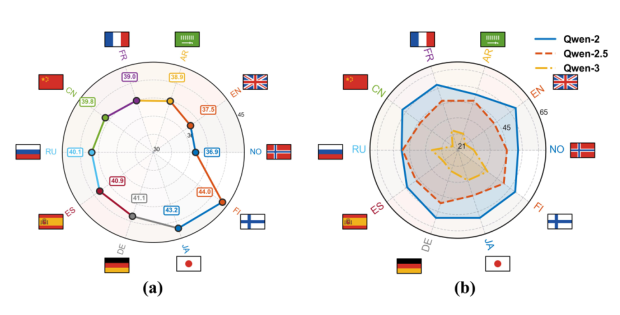 Enlarge ↗
The radar plots compare multilingual safety across evaluated models and model iterations.
Paper, p. 6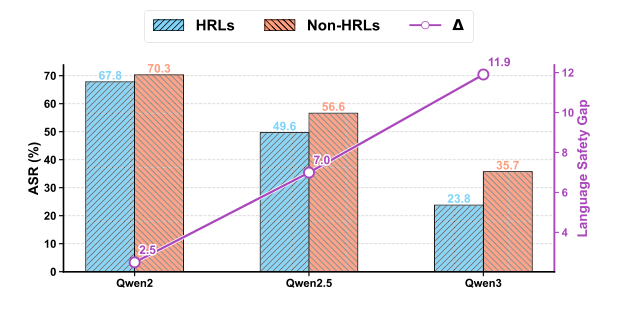 Enlarge ↗
The controlled model-family comparison reports different scaling gains for high-resource and non-high-resource languages.
Paper, p. 10Takeaways
A single aggregate safety score can hide which users and input conditions remain poorly protected. Explicitly controlling the language and the source of risk makes those differences measurable and gives alignment work a more specific target.
The broader opportunity is to connect evaluation coverage to mechanisms of access and understanding. A low attack success rate alone does not reveal whether a model recognized the risk or failed to process the input. The benchmark’s factorized design supports further studies that distinguish these explanations.
Multimodal safety needs evaluation across the interaction of language and risk-bearing modality.
Paper and resources
Lingua-SafetyBench: A Benchmark for Safety Evaluation of Multilingual Vision-Language Models
Paper contact · lencit817@gmail.com