
At a glance
Who Bridges Safety studies multilingual safety as a problem of signal propagation. It identifies cross-layer pathways using both co-activation and activation-propagation measurements, then examines the paths shared by high-resource and non-high-resource languages. The unit of analysis is a connection between components, extending the view provided by isolated-neuron measurements.
The resulting shared pathways guide selective alignment. Masking experiments test their functional relevance, while targeted updates examine whether strengthening the shared computation improves refusal behavior in less well-protected languages without broadly changing the model.
- Unit of mechanistic analysis
- Cross-layer
- Selective alignment target
- Shared paths
- Language-transfer evaluation
- Held-out
Research question
Models can understand a language while failing to apply a safety judgment in it. Locating individual safety-related neurons helps identify relevant components, but leaves open how their signals combine and propagate into a refusal decision.
Method
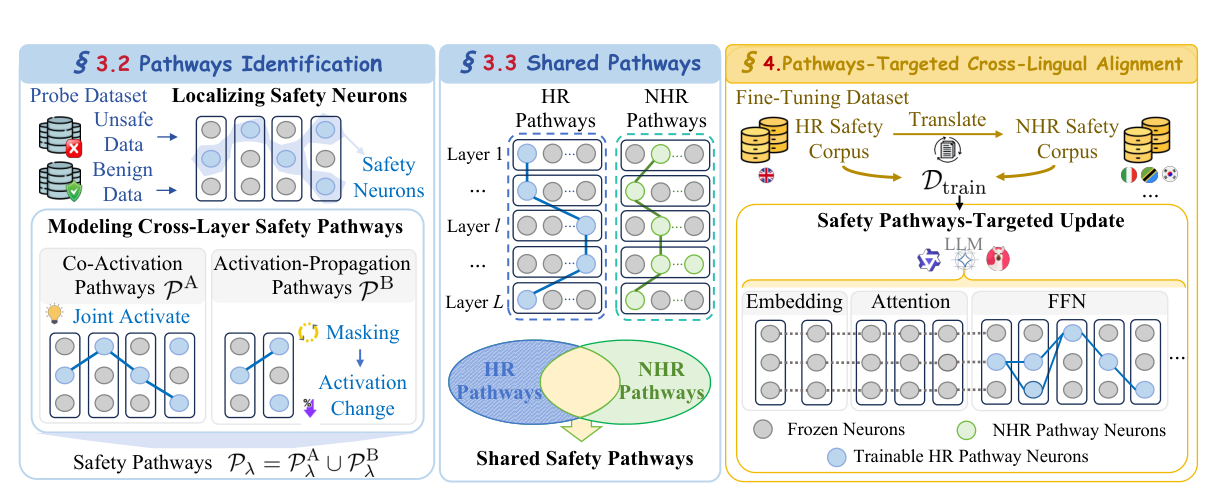
- Identify language-specific safety pathways from cross-layer co-activation and activation propagation.
- Intersect the pathway sets across languages and compare targeted masking with size-matched random controls.
- Concentrate alignment updates on shared pathway parameters and evaluate multilingual safety together with general capabilities.
 Enlarge ↗
The framework combines pathway identification, cross-language intersection, and pathway-targeted alignment.
Paper, p. 3Evidence
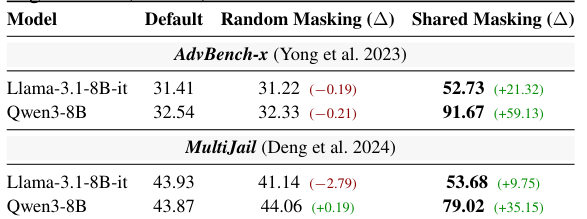
The selected masking controls show larger safety degradation when shared pathways are disrupted than when matched random pathways are disrupted. Multilingual evaluations compare targeted alignment with preference-optimization and cross-language baselines; additional experiments examine training efficiency, general capability retention, and leave-one-language-out transfer.
 Enlarge ↗
Shared-path masking is compared with a size-matched random control on multilingual attacks.
Paper, p. 4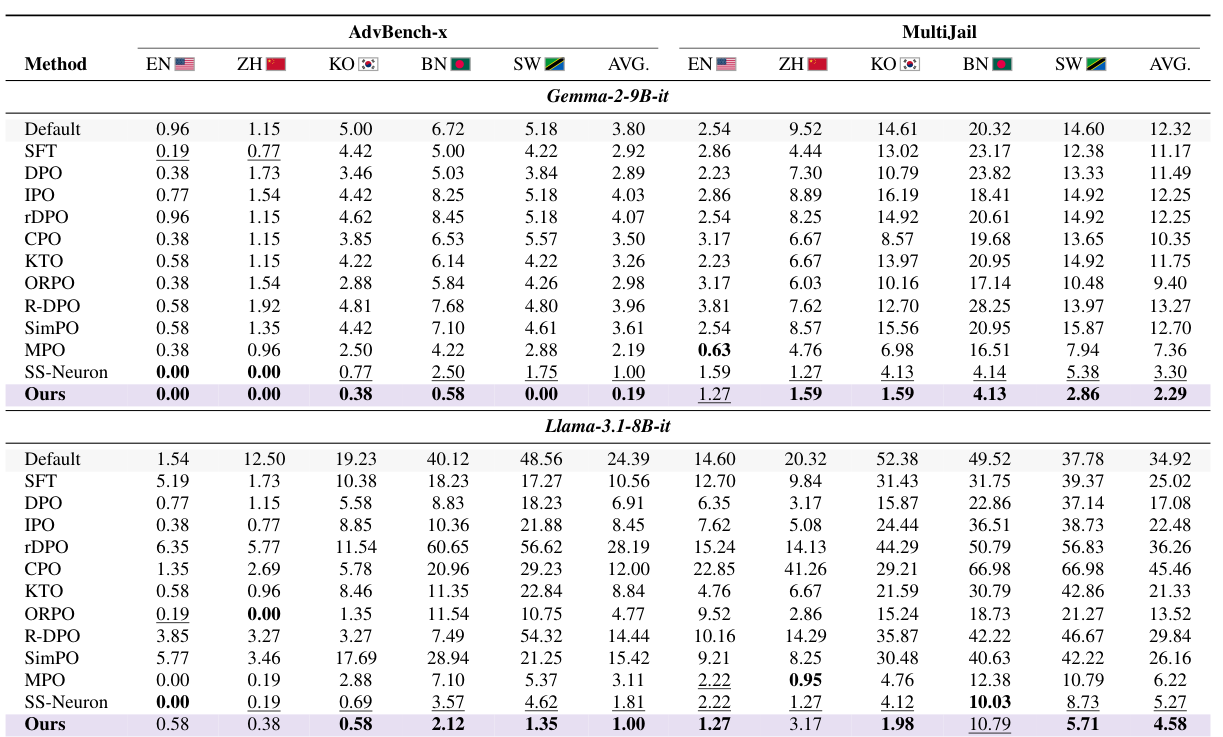 Enlarge ↗
The original table compares attack success rates across languages and alignment methods.
Paper, p. 5Takeaways
The work makes the connectivity of a safety mechanism an explicit research target. A model may contain relevant components yet fail to coordinate them effectively in a particular language. Path-level analysis connects those two possibilities to interventions that can be tested.
This suggests a mechanism-aware approach to transfer: identify a shared computation, validate its role, and then optimize where that computation is carried. The evidence supports the studied pathway constructions and languages; how broadly those bridges generalize remains a question for further controlled evaluation.
A shared safety component matters through the computation it helps carry across layers and languages.
Paper and resources
Who Bridges Safety? Identifying and Targeting Cross-Lingual Shared Safety Pathways
Paper contact · shuyimiao@buaa.edu.cn