
At a glance
A driving model has an image of the road and a history of the vehicle’s motion. An autoregressive model can spell out its planned coordinates one token at a time. Reasoning-VLA instead assigns a query to each future coordinate and predicts the entire sequence of positions in one action-generation pass.
The researchers tested 3B and 7B models built on Qwen2.5-VL. They measured how closely predictions followed recorded trajectories, how the models handled held-out datasets and how long trajectory generation took on the same hardware.
- Public driving datasets
- 8
- Mean position error on the selected nuScenes clips
- 0.23 m
- Ten-position generation on an H200
- 89 ms
Research question
A turn is one maneuver, but its future positions depend on one another. Generating the coordinates in sequence makes prediction time depend on output length. The research question is whether the whole trajectory can be generated together while still using visual context and the model’s reasoning about the scene.
Method
- Align examples from eight public driving datasets in a common format. A vision–language model supplies reasoning annotations for supervised training. Inputs include road images and a history of the vehicle’s own motion.
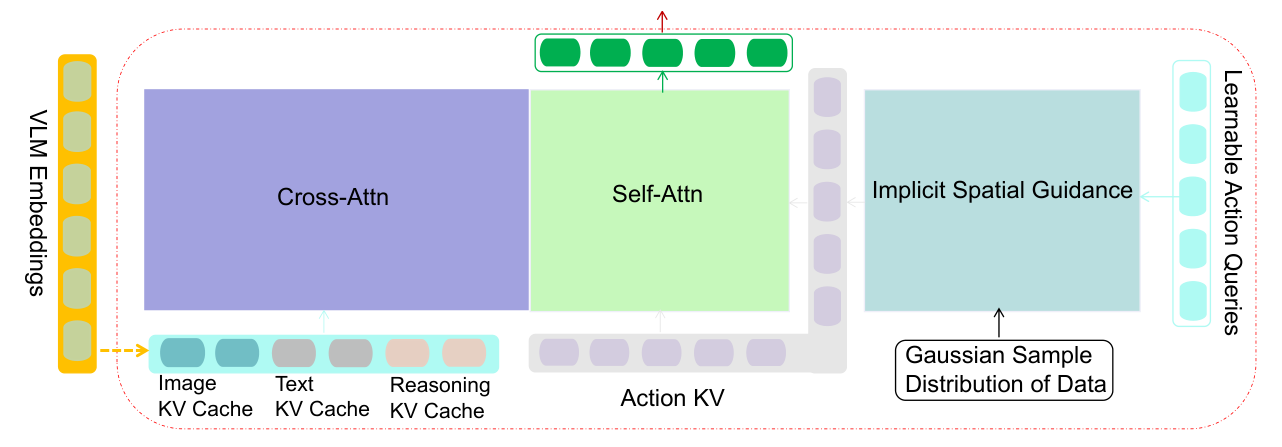
- For each future coordinate, initialize a learnable query from the mean and variance of that coordinate in the training trajectories. The queries attend to one another, then read the vision–language model’s features. A refinement module regresses the continuous coordinates.
- After supervised fine-tuning, optimize the model with GRPO. The reward scores agreement with the recorded trajectory and also accounts for steering and acceleration constraints.
 Enlarge ↗
Spatially initialized queries share information through self-attention. Cross-attention then gives them access to the image, text and reasoning features used by the vision–language model.
Paper, p. 4Evidence
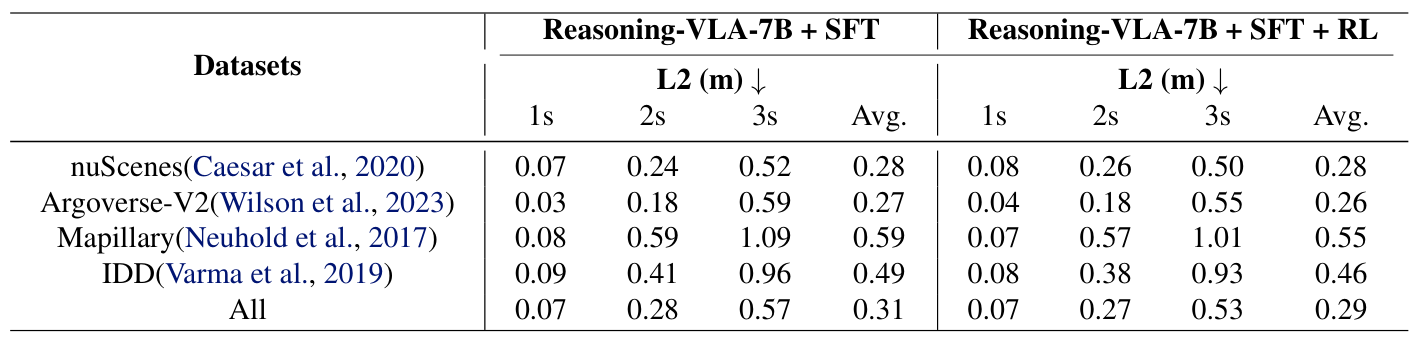
On the nuScenes validation clips selected for the unified dataset, the 7B model had a mean position error of 0.23 m across the one-, two- and three-second horizons (Table 1). In a separate experiment, training used only NAVSIM, Waymo, KITTI and ONCE. With supervised and reinforcement learning, the error on each held-out dataset was 0.28 m on nuScenes, 0.26 m on Argoverse v2, 0.55 m on Mapillary and 0.46 m on IDD (Table 5).
In the ten-position setting on an NVIDIA H200 with vLLM, Reasoning-VLA-7B took 0.089 s per prediction, compared with 5.472 s for autoregressive Qwen2.5-VL-7B (Table 9). This timing covers trajectory generation. Vehicle sensing and actuation would add to it.
 Enlarge ↗
The named rows give results for the four held-out datasets. The final row reports the paper’s unified validation set. Each average combines errors at one, two and three seconds.
Paper, p. 9 Enlarge ↗
For ten future positions, vLLM took 0.089 s with the parallel 7B model and 5.472 s with autoregressive Qwen2.5-VL-7B. The steps column counts model passes.
Paper, p. 15Takeaways
A recorded path measures geometric agreement. In NeuroNCAP’s deliberately hazardous closed-loop scenarios, the 7B model scored 2.25 and had a 59.4% mean collision rate across stationary, frontal and side scenarios (Table 2). These simulated encounters give the open-loop result a concrete boundary.
The gain from the reinforcement-learning stage also varied across the held-out datasets. On Mapillary the mean position error fell from 0.59 to 0.55 m. On nuScenes it stayed at 0.28 m to the precision shown in Table 5.
A parallel action head can use what a vision–language model has inferred about a scene. Its practical value depends on both how quickly it proposes a path and what happens when the vehicle follows it.
Paper and resources
Reasoning-VLA: An Efficient and Spatial-Guided General Vision-Language-Action Reasoning Model for Autonomous Driving
Paper contact · shenfei29@nus.edu.sg