
At a glance
A simulator can repeatedly stage a pedestrian stepping into the road or another car cutting in. Would a model that learned from those scenes recognize the risk in footage from a real vehicle?
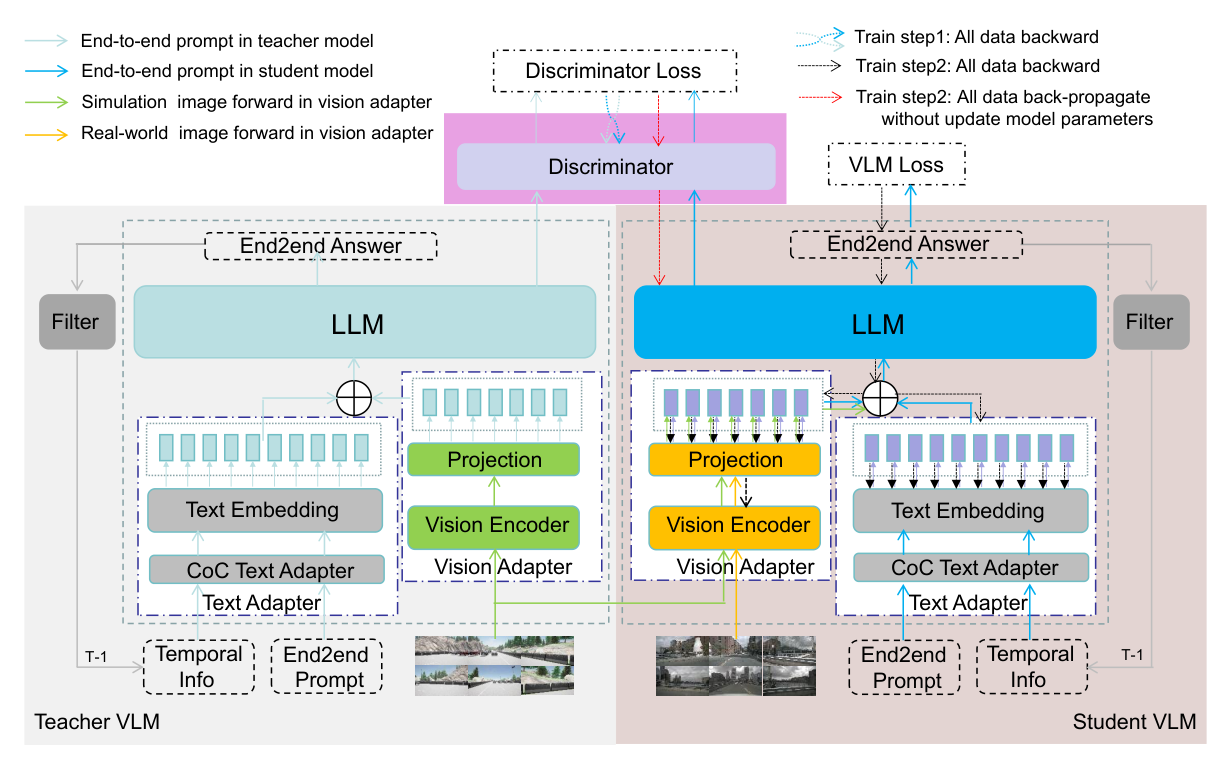
CoC-VLA assigns a model to each setting, then uses adversarial training to transfer features to the student. The student describes the scene, explains a possible response and predicts where the vehicle will go.
- CARLA-VLM simulation clips
- 600
- Open-loop ADE on nuScenes-VLM
- 1.44
- Mean closed-loop NeuroNCAP score
- 3.32
Research question
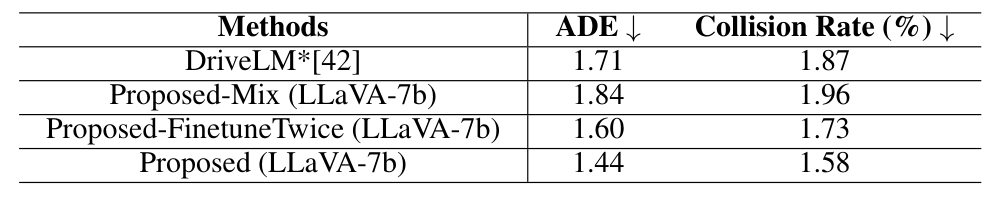
Would pooling the data suffice? In the authors’ nuScenes-VLM experiment, mixing the datasets gives an average displacement error (ADE) of 1.84. Using only the recorded data gives 1.66. That comparison motivates a different experiment: train a specialist in each setting and align their features while updating the student.
Method
- Train a teacher on CARLA-VLM simulations and a student on nuScenes-VLM road recordings. Both start from LLaVA-v1.5-7B and retain their own parameters.
- Condense the preceding frame’s answer into a short prompt. Given that prompt, current images and a question, the model describes road users, their motion and possible risks before predicting the vehicle’s trajectory.
- Alternate two updates. First train the discriminator to distinguish features from the two domains. Then hold it fixed and update the student using the driving and adversarial objectives together.
 Enlarge ↗
The teacher reads simulated scenes on the left. The student reads recorded driving scenes on the right. Their features meet at the discriminator. Both branches carry a short description forward from the preceding frame.
Paper, p. 2Evidence
The first table scores predicted trajectories against fixed recordings. In the second, the simulated scene responds to the model’s predictions. Collision rates are comparable within each table because the two tests expose the vehicle to different conditions.
 Enlarge ↗
On the nuScenes-VLM open-loop test, fine-tuning on simulation and then on real data gives an average displacement error (ADE) of 1.60 and a collision rate of 1.73%. Adversarial transfer lowers them to 1.44 and 1.58%. Lower is better in both columns.
Paper, p. 9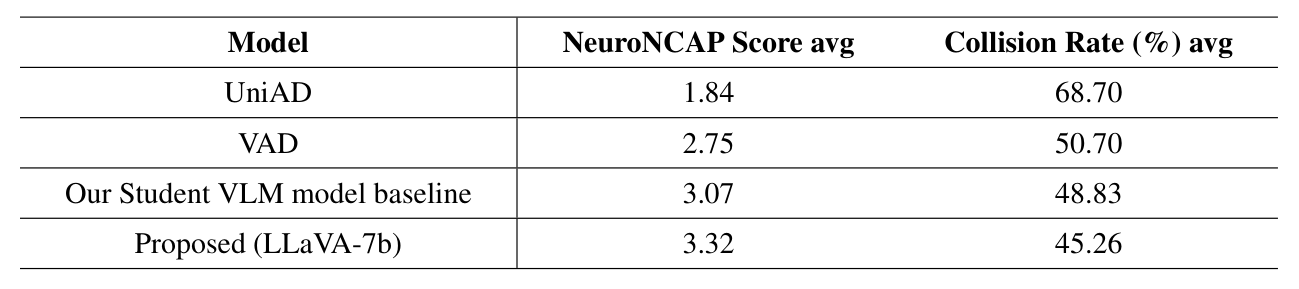 Enlarge ↗
In the NeuroNCAP closed-loop scenarios reported in the appendix, CoC-VLA raises the mean score from 3.07 to 3.32 and lowers the mean collision rate from 48.83% to 45.26%, compared with the student trained only on real data.
Paper, p. 23Takeaways
How simulation enters training changes the result. Pooling the datasets increased trajectory error in this comparison. Training separate models and aligning their features gave the student a lower error on the road recordings.
The average closed-loop collision rate still reached 45.26% in the reported simulator scenarios. The authors also identify the cost of training two models and the latency of 7B-model inference as deployment constraints. Performance in actual traffic remains an open question.
Testing transfer means asking which trajectory changes on a new scene, and what happens when the simulated vehicle follows it.
Paper and resources
CoC-VLA: Delving into Adversarial Domain Transfer for Explainable Autonomous Driving via Chain-of-Causality Visual-Language-Action Model
Paper contact · shenfei29@nus.edu.sg