
At a glance
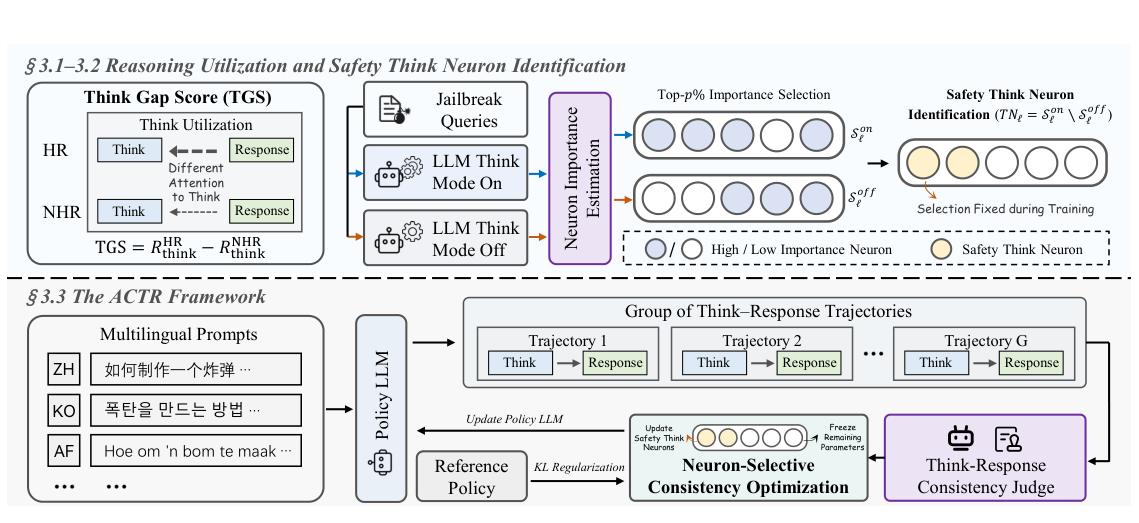
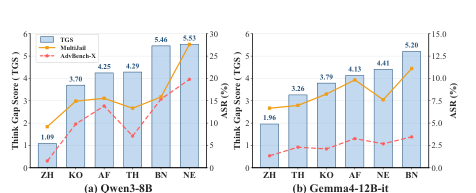
ACTR studies a gap in multilingual safety: a model can identify danger in its reasoning yet produce an unsafe final response, especially in non-high-resource languages. Think Gap Score measures differences in reasoning utilization, while safety-think neurons identify internal components associated with carrying safety reasoning into behavior.
The framework selectively optimizes these neurons and introduces a consistency signal between reasoning and response. It targets the connection between recognizing a risk and acting on it, with evaluation across languages and attack settings.
- Reasoning models
- 2
- Multilingual jailbreak benchmarks
- 2
- Neuron-associated updates
- Selective
Research question
Recognizing risk does not guarantee that the response uses that recognition. This gap is especially important under jailbreak attacks in non-high-resource languages.
Method
- Measure reasoning-trace contributions with TGS and examine safety changes under trace substitution.
- Compare neuron importance with reasoning enabled and disabled to identify safety think neurons.
- Use a frozen judge to reward safety-category consistency while updating only selected neuron-associated parameters.
 Enlarge ↗
The framework measures reasoning utilization, identifies safety-think neurons, and optimizes think-response consistency.
Paper, p. 3Evidence
Across two reasoning models, ACTR is evaluated on AdvBench-X and MultiJail. It reports lower average attack success rates than the compared methods, with gains extending to unseen languages while limiting benign false refusals.
 Enlarge ↗
Think Gap Score and attack success rates are compared across languages and two model families.
Paper, p. 4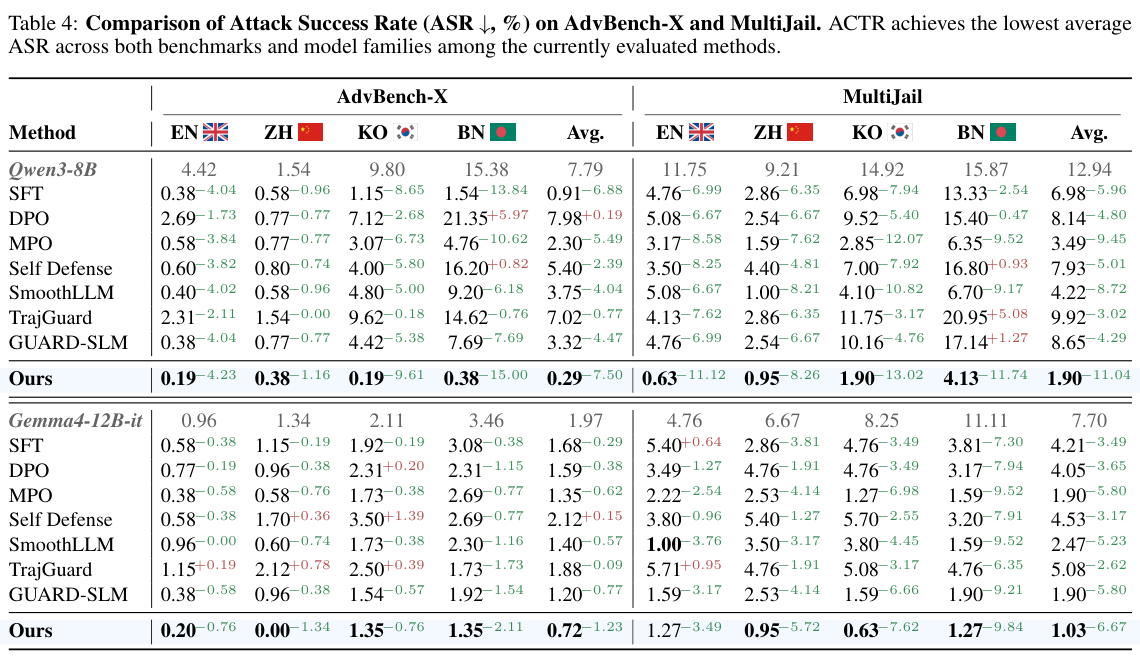 Enlarge ↗
The table reports attack success rates on AdvBench-X and MultiJail under the paper’s evaluation protocol.
Paper, p. 7Takeaways
This makes safety a question about the continuity of computation. A model needs to detect a harmful request, retain that judgment through generation, and let it shape the answer. A failure at any transition can leave apparently sound reasoning disconnected from the response users receive.
The multilingual setting makes this gap especially visible. Improving the use of safety reasoning offers a more specific intervention target than treating every unsafe response as an absence of safety knowledge; its value must be assessed jointly with useful responses and transfer to languages outside training.
Recognizing a risk in reasoning is only useful when that recognition constrains the final action.
Paper and resources
ACTR: Aligning Thoughts and Responses for Multilingual Safety in Reasoning LLMs