
At A Glance
An image query can be partly hidden, and a text query can lose words. The right answer and its closest distractor may still name the same object. The evidence that distinguishes them often concerns an action, a location or a relationship.
- Datasets
- Flickr30K / COCO
- Frozen backbone configurations
- 4
- Incomplete-query settings
- 72
Research Question
For each query, compare the similarity of a correct match with that of a competing candidate. Even when the subject remains recognisable, a smaller gap can reverse their order. Can we improve a damaged query while preserving the distinctions it already makes?
Method
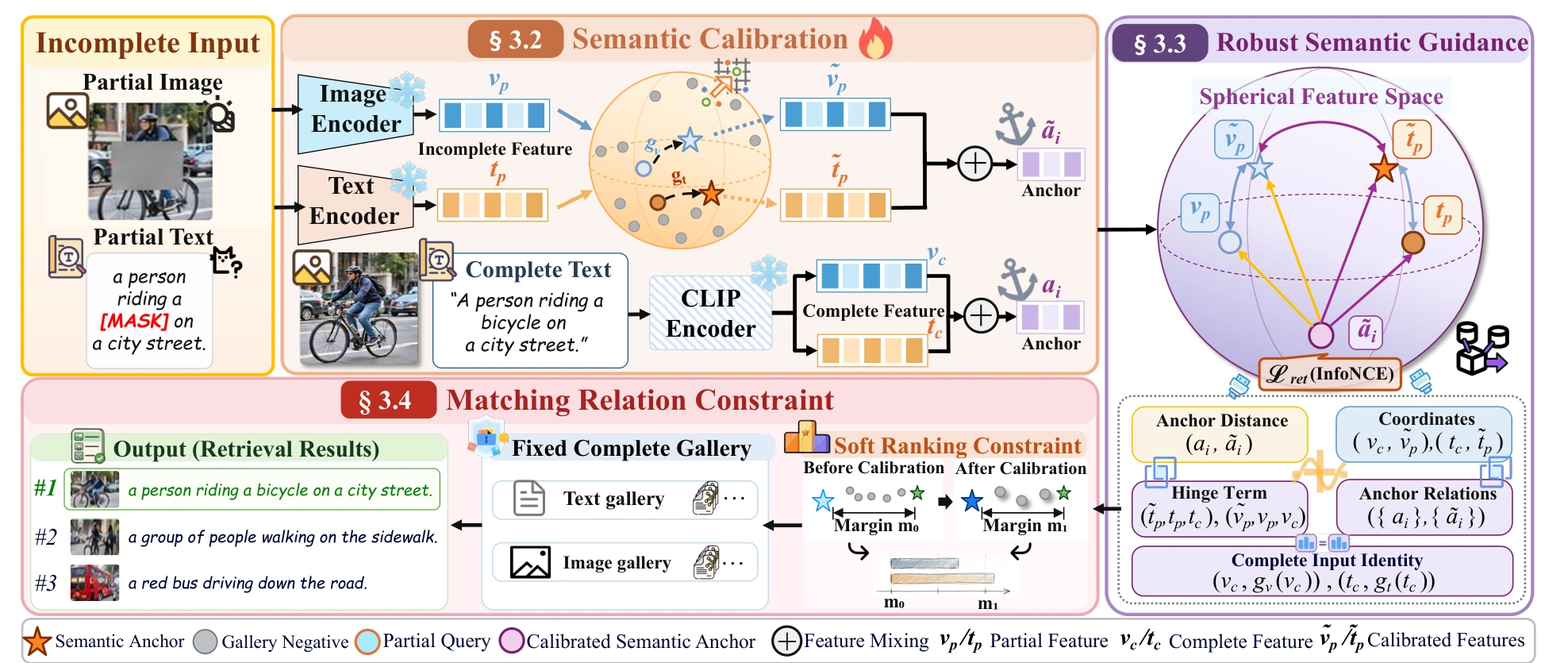
- Freeze the image and text encoders. Learn updates in the tangent spaces of their unit spheres and map the results back to the spheres to preserve cosine-similarity scoring.
- During training, complete image–text features and cross-modal semantic anchors guide the update. A contrastive objective helps the calibrated query distinguish a true match from similar candidates.
- Mix the original and calibrated features. A soft ranking penalty discourages reductions in an initially positive margin. At inference, only the incoming query is calibrated, so the existing gallery features can be reused.
 Enlarge ↗
Complete features and semantic anchors guide training. At search time, the incomplete query is adjusted and compared with the fixed gallery.
Paper, p. 5Evidence
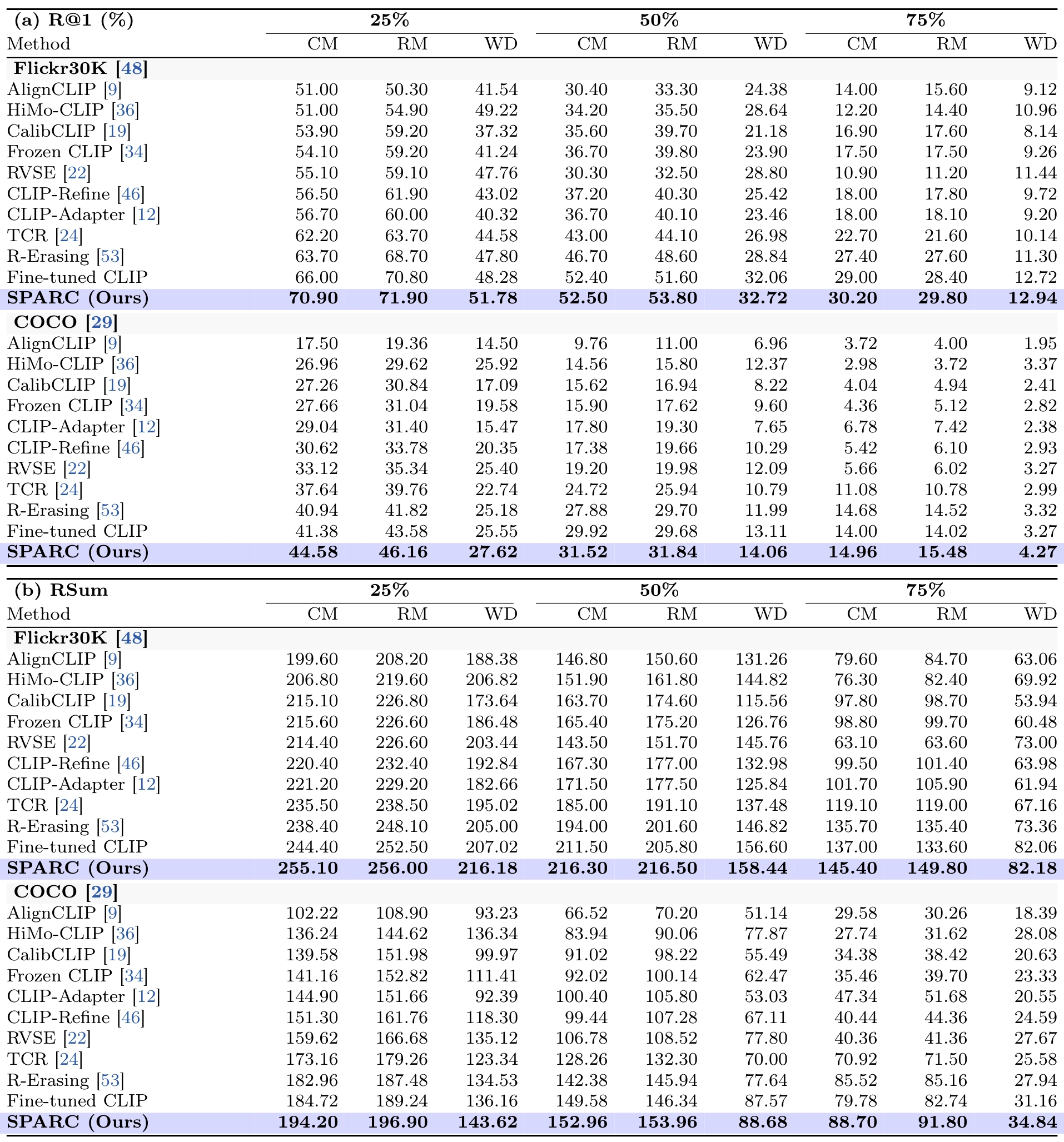
Flickr30K and COCO are evaluated with four frozen encoder configurations. The study tests central and random image masking and random word deletion, each at 25%, 50% and 75%. Together these choices give 72 incomplete-query settings.
With CLIP ViT-B/32 on Flickr30K, masking the central 25% of an image gave 54.10% R@1 with frozen CLIP and 70.90% with SPARC. In the reverse direction on COCO, deleting 25% of the query words gave 19.58% and 27.62%. R@1 measures how often the first result is correct.
 Enlarge ↗
The upper panel reports R@1 and the lower panel sums R@1, R@5 and R@10. CM, RM and WD denote central masking, random masking and word deletion at each severity.
Paper, p. 6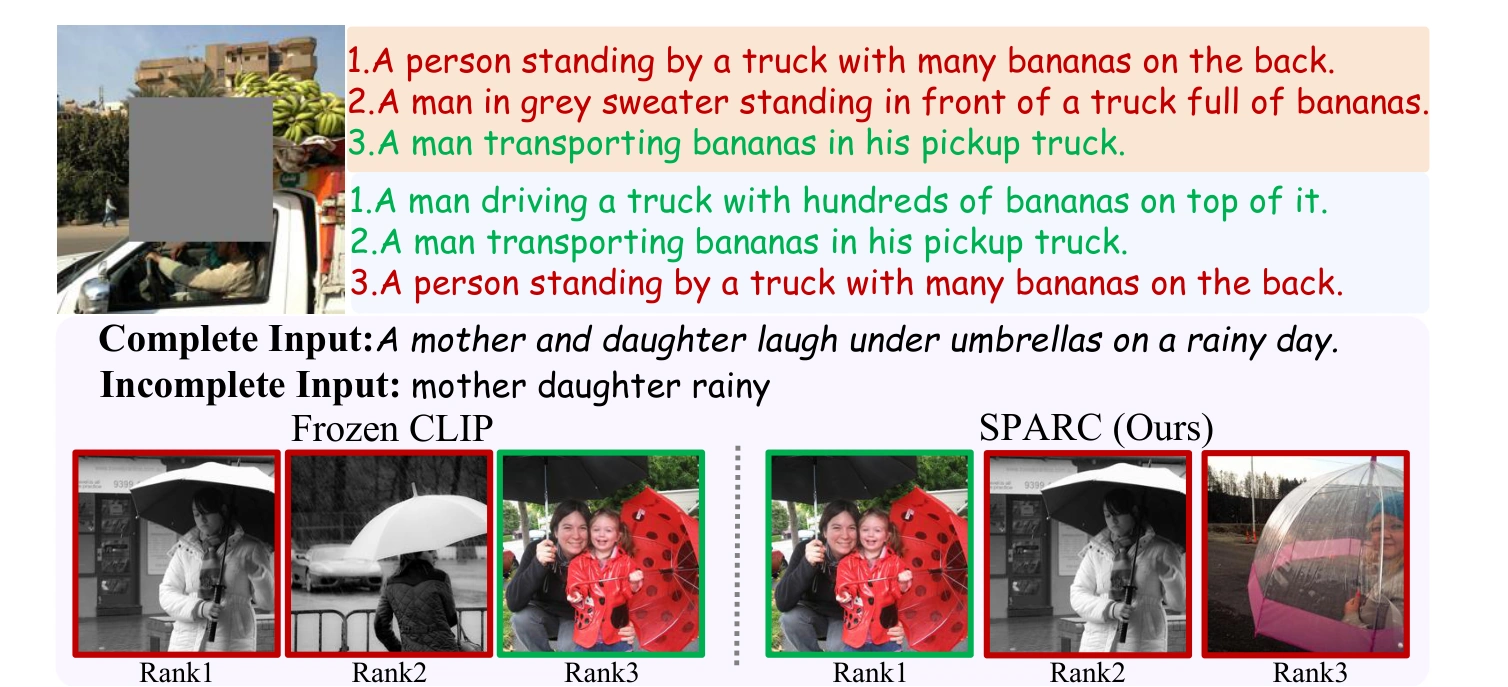 Enlarge ↗
The upper example ranks captions for a partially masked truck image. The lower example keeps three words from a caption and compares the first three images retrieved by each method.
Paper, p. 10Takeaways
The amount of surviving evidence still matters. Raising COCO word deletion from 25% to 75% reduced SPARC’s text-to-image R@1 from 27.62% to 4.27%. Reporting each severity shows where a calibrated query can still identify the intended image.
Calibrating the query lets a retrieval system reuse its gallery. The position of the true match among close distractors shows what that correction changes.
Paper And Resources
SPARC: Semantic Calibration with Latent Multimodal Knowledge for Robust Image-Text Retrieval
Paper Contact · shenfei29@nus.edu.sg
Cite This Paper
@misc{mao2026-sparc,
  title = {{SPARC: Semantic Calibration with Latent Multimodal Knowledge for Robust Image-Text Retrieval}},
  author = {Mao, Zhongkuan and Zhao, Wenzhuo and Chen, Haidong and Li, Shangze and Wang, Yidong and Bi, Jinhe and Ma, Yunpu and Fang, Junfeng and Shen, Fei and Chua, Tat-Seng},
  year = {2026},
  eprint = {2611.34344},
  archivePrefix = {arXiv},
  url = {https://arxiv.org/abs/2611.34344}
}