
At A Glance
A connector translates image features into inputs a language model can read. Using matched probes, we recover object identities, counts and spatial relations more readily from the original visual features than from the adapted features.
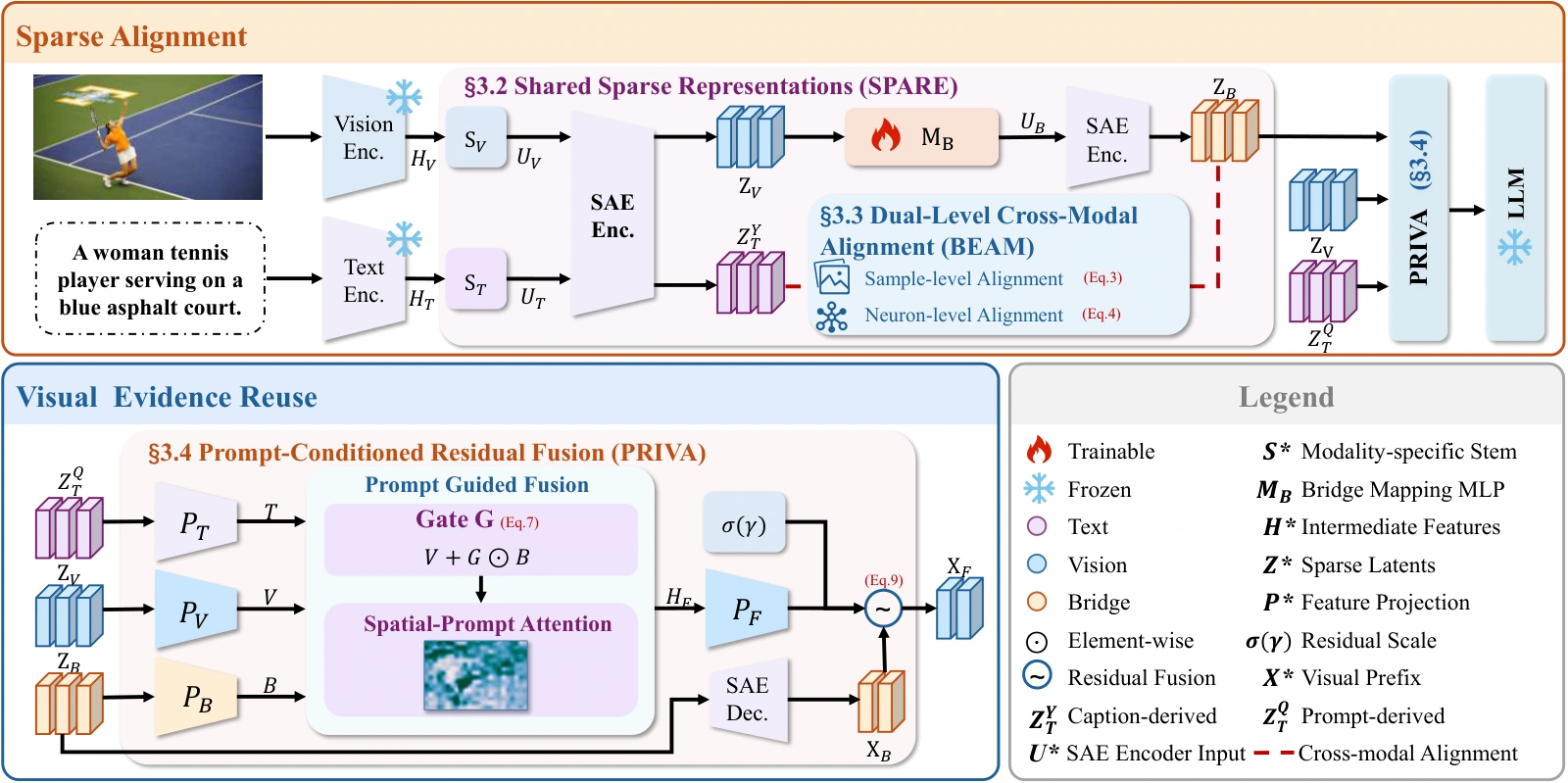
SAVERA keeps both representations. A shared sparse encoder gives image and text features common coordinates for alignment. At generation time the prompt helps select evidence from the original and adapted image features.
- COCO caption CIDEr
- 0.5621
- Captions with a hallucinated object
- 9.08%
- POPE object-presence accuracy
- 82.90%
Research Question
Adapting an image for a language model can make spatial detail harder to recover. A spatial-relation probe reached 76.1% on the original visual features and 65.5% on the adapted features. Can a connector still give the language model access to that detail when the question calls for it?
Method
- With SPARE, we encode original visual features, adapted visual features and text with a shared soft-gated sparse encoder. Each stream has its own decoder to reconstruct its input from the common coordinates.
- BEAM learns a nonlinear mapping into the bridge representation. It matches images with their captions in both directions and aligns how individual sparse coordinates respond across a batch of paired examples.
- PRIVA uses the current prompt to gate and attend to the original and adapted visual streams. It adds the resulting correction to the visual prefix consumed by Vicuna. Both Vicuna and DINOv2 stay frozen throughout connector training.
 Enlarge ↗
The top half shows how the shared encoder represents three streams and aligns the bridge with paired captions. The lower half shows how a prompt guides a correction to the visual prefix before generation.
Paper, p. 4Evidence
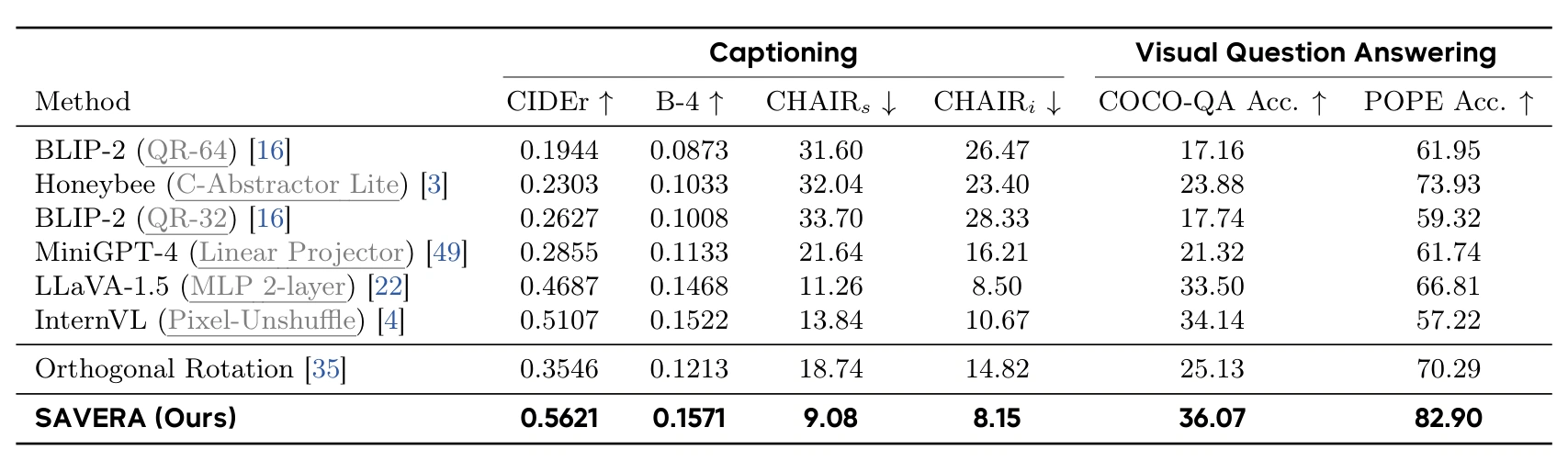
We trained all connectors on CC3M image–caption pairs. On the 5,000-image COCO test split, SAVERA scored 0.5621 CIDEr compared with 0.5107 for the strongest baseline on that metric. An ungrounded object appeared in 9.08% of SAVERA captions, and 8.15% of object mentions were ungrounded.
Removing PRIVA lowered CIDEr to 0.5009 and raised the share of captions with a hallucinated object to 13.68%. With the full connector, question-answering accuracy reached 36.07% on COCO-QA and object-presence accuracy reached 82.90% on POPE.
 Enlarge ↗
All rows use DINOv2-L/14, Vicuna-7B-v1.5 and CC3M training pairs. CIDEr measures agreement with reference captions. The two CHAIR columns track hallucinated objects at the caption and object-mention levels.
Paper, p. 6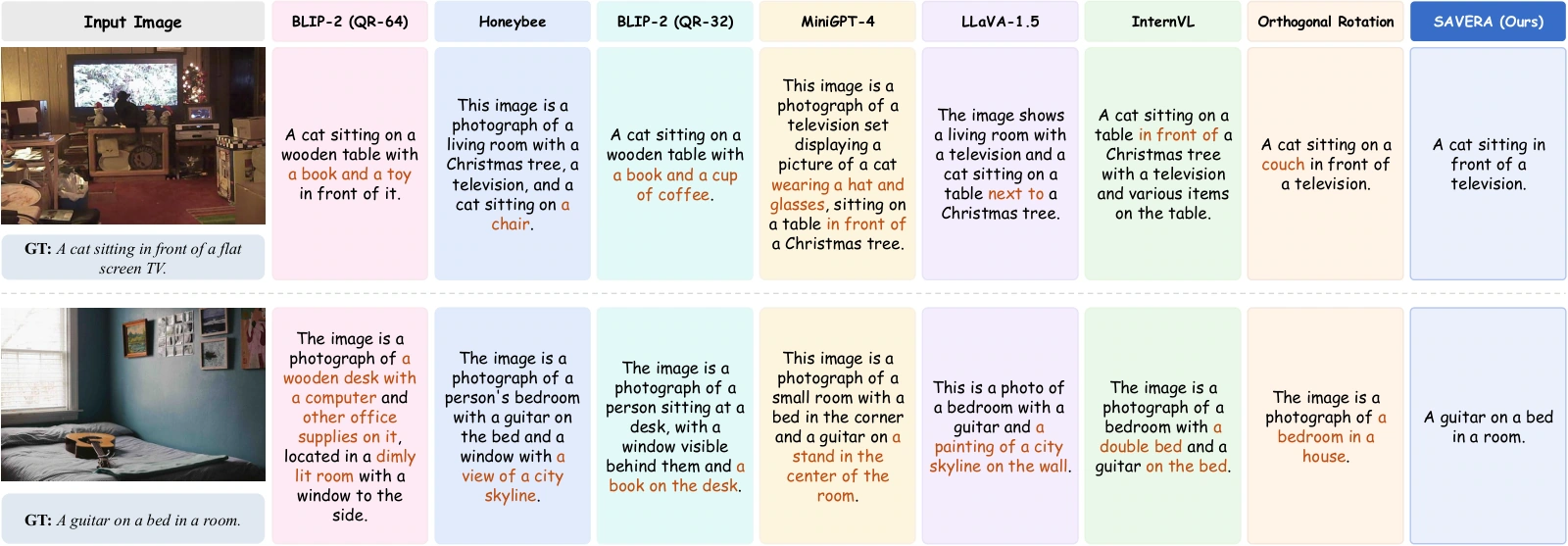 Enlarge ↗
In the second row, SAVERA places the guitar on the bed, matching the reference. Other captions introduce a computer, a guitar stand or a city outside the window.
Paper, p. 6Takeaways
Two checks make this interface easier to evaluate. Probe the same details before and after language adaptation, then remove access to the original features during generation and examine which objects and relationships change in the answers.
In these experiments, retaining access to the original image features helped the frozen language model describe the objects and spatial relationships in a scene.
Paper And Resources
SAVERA: Bridging Frozen Vision and Language Models via Sparse Alignment and Visual Evidence Reuse
Paper Contact · jiajun.shen@u.nus.edu
Cite This Paper
@misc{shen2026-savera,
  title = {{SAVERA: Bridging Frozen Vision and Language Models via Sparse Alignment and Visual Evidence Reuse}},
  author = {Shen, Jiajun and Shi, Chuancheng and Lyu, Jiayi and Sun, Yanpeng and Shen, Fei and Chua, Tat-Seng},
  year = {2026},
  eprint = {2611.32828},
  archivePrefix = {arXiv},
  url = {https://arxiv.org/abs/2611.32828}
}