
At A Glance
Neighbouring frames can depict nearly identical scenes. A single vector for the whole frame can average away the small changes in outline or pose that distinguish them. PRAM reads both whole-frame and local features from frozen encoders and lets each contribute evidence to the ranking.
- Datasets
- 10
- Top classification results, including ties
- 16 / 17
- Top retrieval results by R@10
- 19 / 20
Research Question
Depth values describe distance and thermal values describe temperature. Their values can look quite different at the same location. Can statistical relationships measured in corresponding regions of a shared pivot modality reveal which two frames belong together?
Method
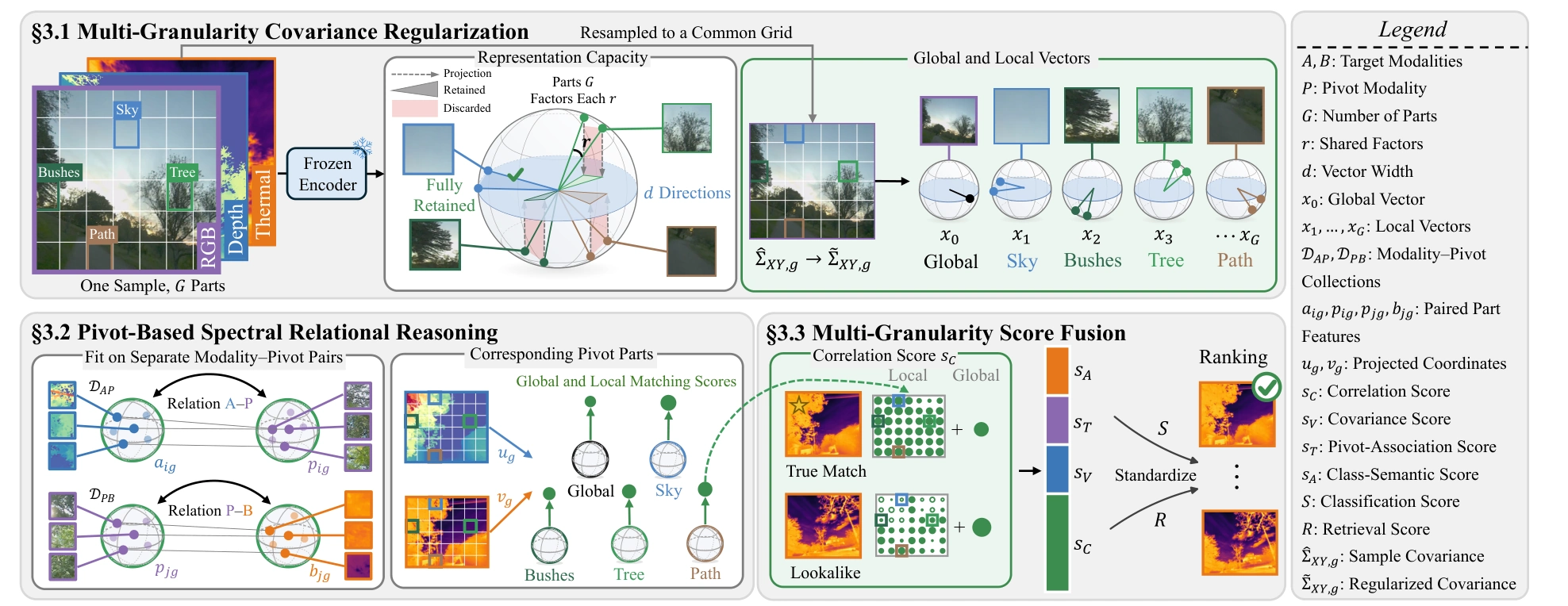
- Estimate global and local feature covariances for each observed modality–pivot pair. Blend local estimates with their cross-part means to stabilise measurements from limited data.
- Compose the two sets of covariances through the pivot. Whitening and spectral decomposition give a pair of projection directions and a correlation strength for each component, without needing a training pair from the two target modalities.
- Standardise and combine global and local matching scores. These scores rank candidate samples for retrieval and combine with class semantics for classification.
 Enlarge ↗
The model gathers global and local statistics, composes them through matching pivot regions and combines the scores across scales.
Paper, p. 4Evidence
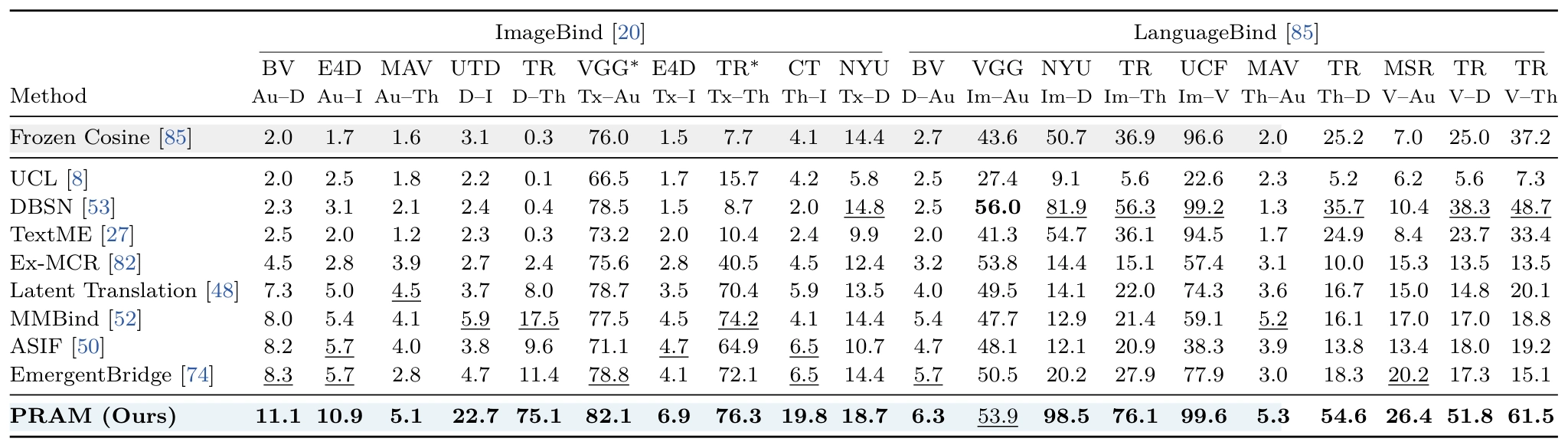
Across ten datasets, PRAM reached the highest top-1 accuracy in 16 of 17 classification settings, including a tie, and the highest bidirectional R@10 in 19 of 20 retrieval settings among methods using only pivot pairs.
On TartanRGBT depth–thermal retrieval with ImageBind, bidirectional R@10 was 17.5% for MMBind and 75.1% for PRAM. R@10 measures how often the correct match appears in the first ten results. The bidirectional score averages the two search directions.
 Enlarge ↗
The ImageBind TR D–Th column compares depth-to-thermal and thermal-to-depth retrieval together. MMBind reaches 17.5% and PRAM reaches 75.1%.
Paper, p. 7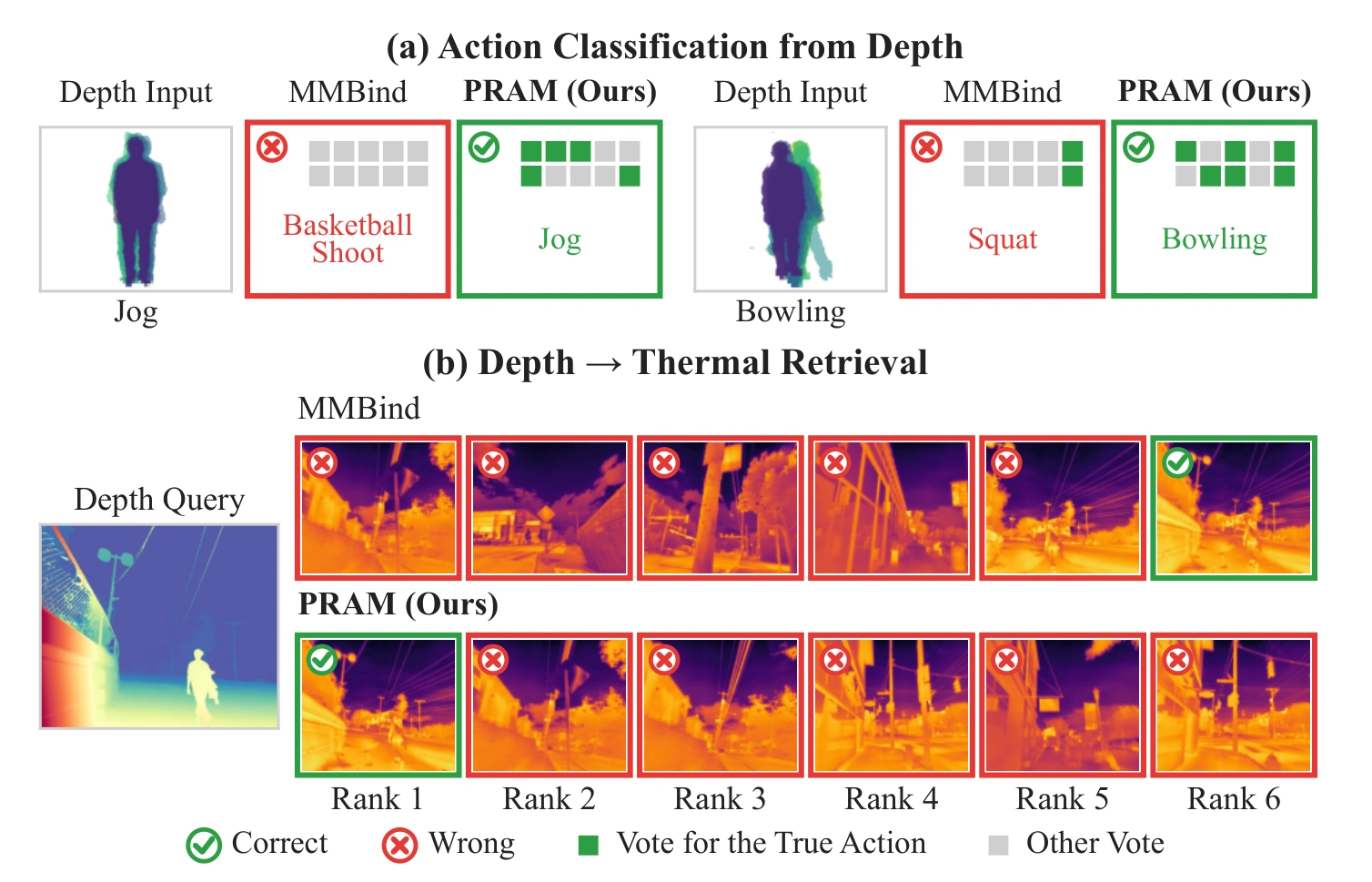 Enlarge ↗
The upper panel shows jogging and bowling examples. In the lower panel, a correct thermal frame moves from sixth with MMBind to first with PRAM. The examples are drawn from cases that PRAM got right and MMBind missed.
Paper, p. 7Takeaways
Holding the TartanRGBT features fixed, bidirectional R@10 rose from 21.7% with one part to 75.1% with 42 parts. This comparison isolates the contribution of spatial detail within the same encoder.
When candidate frames share a scene, correspondence through a local pivot region can distinguish details that whole-frame matching misses.
Paper And Resources
PRAM: Activating Latent Multimodal Knowledge through Partwise Reasoning
Paper Contact · shenfei29@nus.edu.sg
Cite This Paper
@misc{chen2026-pram,
  title = {{PRAM: Activating Latent Multimodal Knowledge through Partwise Reasoning}},
  author = {Chen, Haidong and Guo, Ying and Li, Shangze and Mao, Zhongkuan and Xu, Linrui and Xiao, Canran and Shen, Fei and Chua, Tat-Seng},
  year = {2026},
  eprint = {2611.34640},
  archivePrefix = {arXiv},
  url = {https://arxiv.org/abs/2611.34640}
}