
At a glance
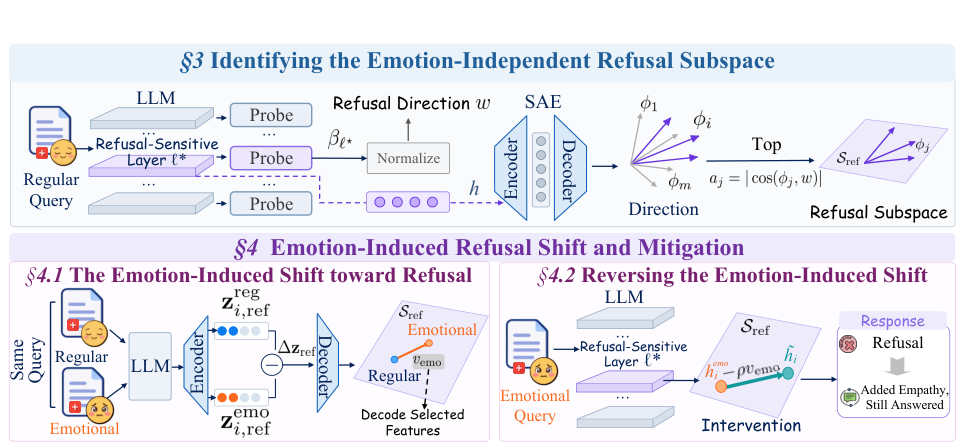
EmoRSS investigates why emotional expression can push benign requests toward refusal. Paired queries isolate the change in expression, and sparse autoencoder features connect that change to a refusal-related subspace. The method then reverses the estimated shift during inference while keeping the underlying model frozen.
The study evaluates benign assistance and harmful-request refusal together. This matters because a lower refusal rate is useful only when it reflects better calibration of legitimate requests, while preserving the model’s ability to reject harmful ones.
- Language models evaluated
- 2
- Refusal-subspace features
- SAE
- No backbone parameter updates
- Frozen
Research question
Safety decisions should depend on the requested action as well as its context. Benign queries can be unnecessarily refused when emotional expression increases refusal tendencies.
Method
- Locate a refusal-sensitive layer with linear probes and construct an SAE-based refusal subspace.
- Compare paired regular and emotional versions of the same queries to estimate a mean feature shift.
- Decode that shift into a hidden-state vector and intervene in the reverse refusal direction without backbone updates.
 Enlarge ↗
The framework identifies a refusal-related subspace and reverses the estimated emotional shift during inference.
Paper, p. 3Evidence
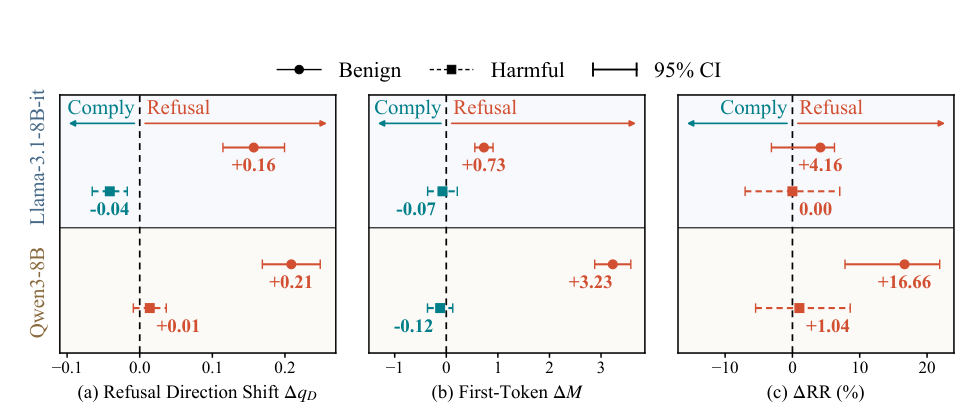
Experiments on two LLMs jointly examine harmful-request refusal, benign-request answering, and general performance. The reported trade-off is more favourable than the compared over-refusal mitigation baselines under emotional wording.
 Enlarge ↗
Paired benign and harmful queries are compared in representation, first-token, and full-response measurements.
Paper, p. 6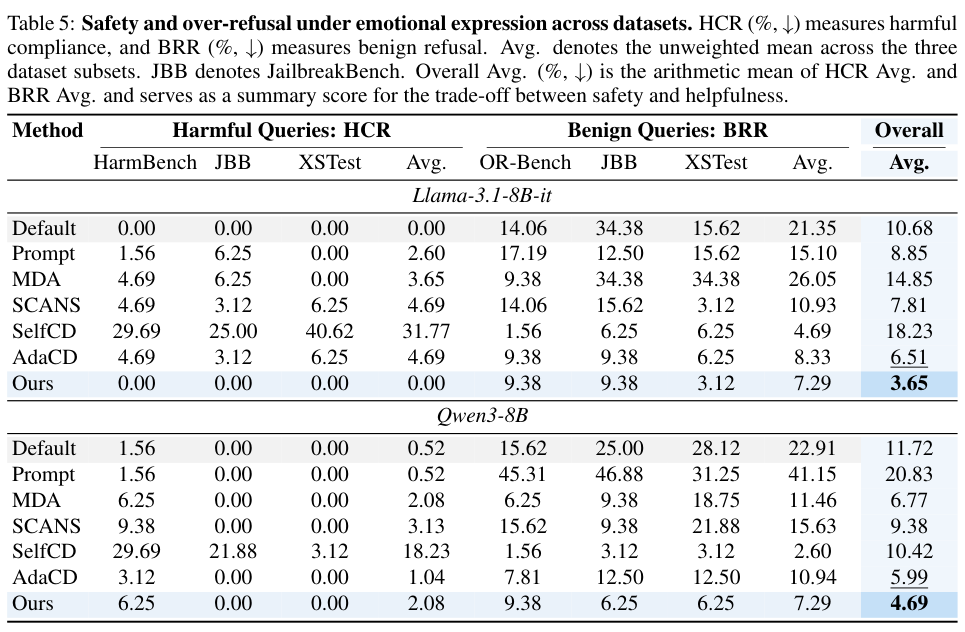 Enlarge ↗
The original table reports harmful compliance and benign refusal under emotional expression; the metrics must be read jointly.
Paper, p. 7Takeaways
Helpful safety requires sensitivity to what a user is asking for and stability to how that need is expressed. Emotional distress can be part of a legitimate request; treating that expression as a substitute for risk can systematically withhold assistance from the people who need it.
By connecting a behavioral disparity to an intervenable internal direction, this work offers a mechanism for studying that calibration. Its scope is defined by the tested models and paired-query settings, motivating broader evaluation across emotions, tasks, and conversational contexts.
Safety calibration depends on distinguishing harmful intent from the emotional form of a legitimate request.
Paper and resources
EmoRSS: Mitigating Emotion-Induced Over-Refusal in Large Language Models
Paper contact · shuyimiao@buaa.edu.cn