
At A Glance
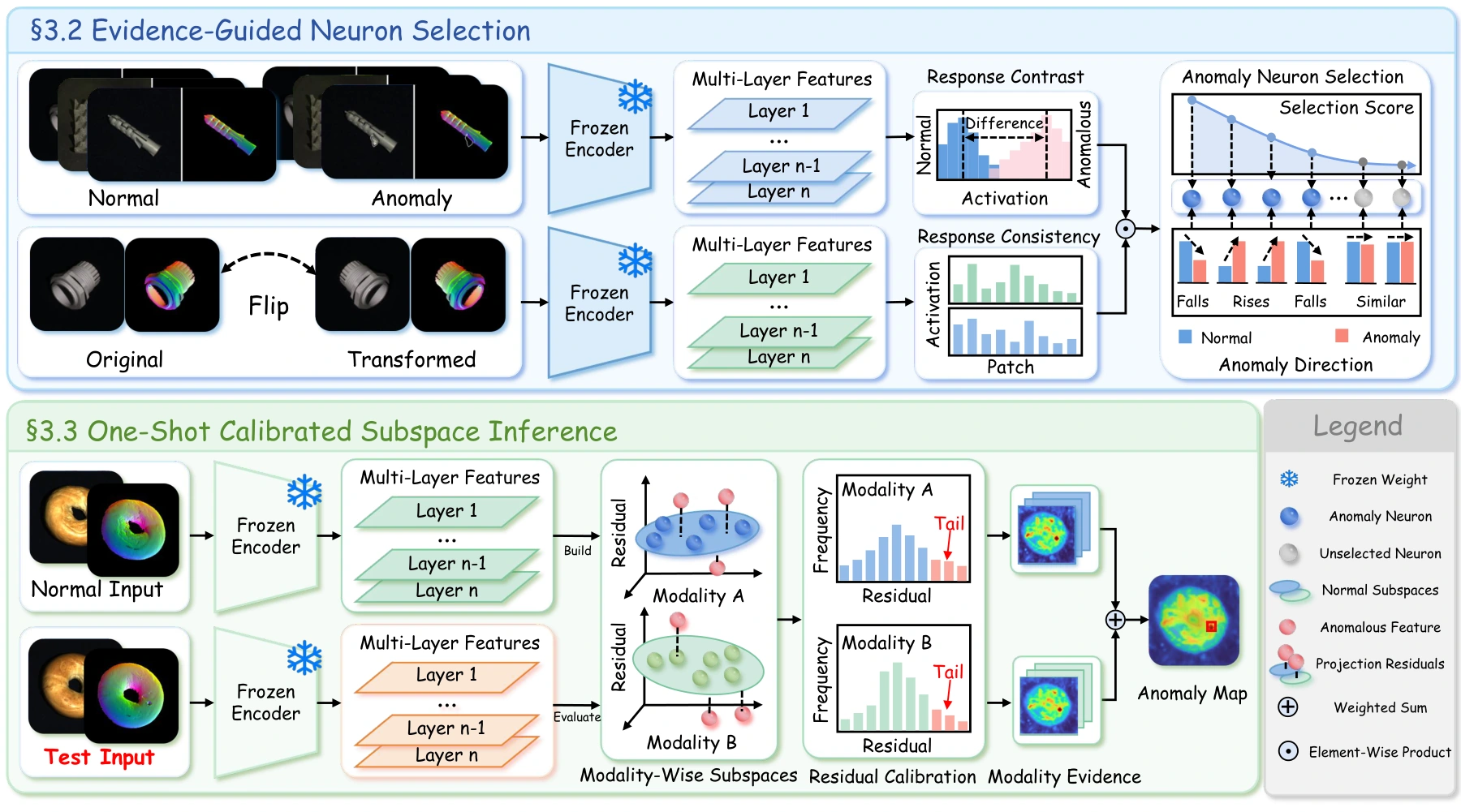
UnifiedAD works with a single image or a spatially aligned RGB–XYZ pair. It selects neurons in a frozen encoder that distinguish anomalies in auxiliary data and respond consistently to transformed views of the target reference.
At test time, a patch supplies two signals. Its features can fall outside the low-rank subspace estimated from normal patches, or they can move along a direction previously associated with anomalies. The method calibrates each signal against the variation seen in the normal reference.
- Normal RGB–XYZ support per MVTec 3D-AD category
- 1 pair
- Image-level AUROC on MVTec 3D-AD
- 92.8%
- Pixel-level average precision on MVTec 3D-AD
- 62.5%
Research Question
A large activation in an RGB feature and a large activation in a geometry feature can have quite different meanings. With only one defect-free item from a new category, how can an inspector combine the two measurements without letting the modality with the larger numerical scale dominate?
Method
- We estimate neuron-wise anomaly effects from a separate source dataset. Across eight auxiliary categories, we use 64 normal images and 128 anomalous images with pixel masks. We rank neurons by this prior and by their stability when a normality-preserving transformation is applied to the target reference.
- We fit a low-rank subspace to the selected neurons’ spatial responses, separately for each layer and modality. For a query patch, we compute its projection residual and its response along the auxiliary anomaly direction.
- We compare each signal with its own reference distribution to estimate how rarely a normal patch produces a response at least as large. We combine the calibrated maps across layers and available modalities. We upsample for pixel localization and take the maximum for image-level detection.
 Enlarge ↗
The upper panel selects neurons using auxiliary anomaly information and the stability of the normal reference. The lower panel fits a subspace for each modality and combines calibrated patch evidence.
Paper, p. 4Evidence
With one normal image per category, pixel-level average precision was 68.4% on MVTec-AD and 52.2% on VisA. The auxiliary source was swapped between these two datasets so that the discriminative priors were estimated outside the benchmark being evaluated.
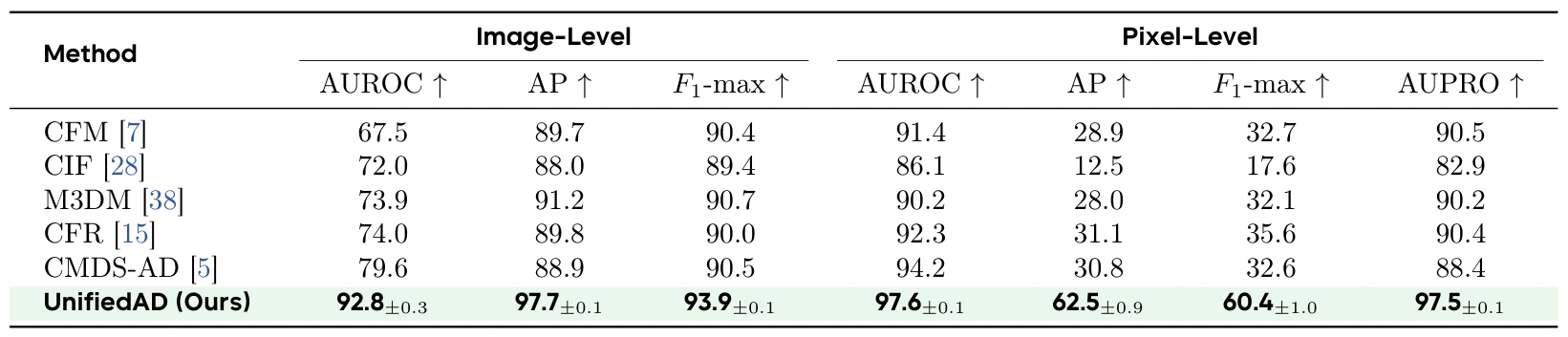
On the ten categories of MVTec 3D-AD, one aligned RGB–XYZ pair per category yielded 92.8 ± 0.3% image-level AUROC and 62.5 ± 0.9% pixel-level average precision across three independently sampled support sets. Removing empirical-tail calibration lowered pixel-level average precision to 44.8% in the controlled ablation.
 Enlarge ↗
Table 2 compares image-level detection and pixel-level localization on MVTec 3D-AD. UnifiedAD values are means and sample standard deviations across three support seeds. Each baseline was evaluated once.
Paper, p. 6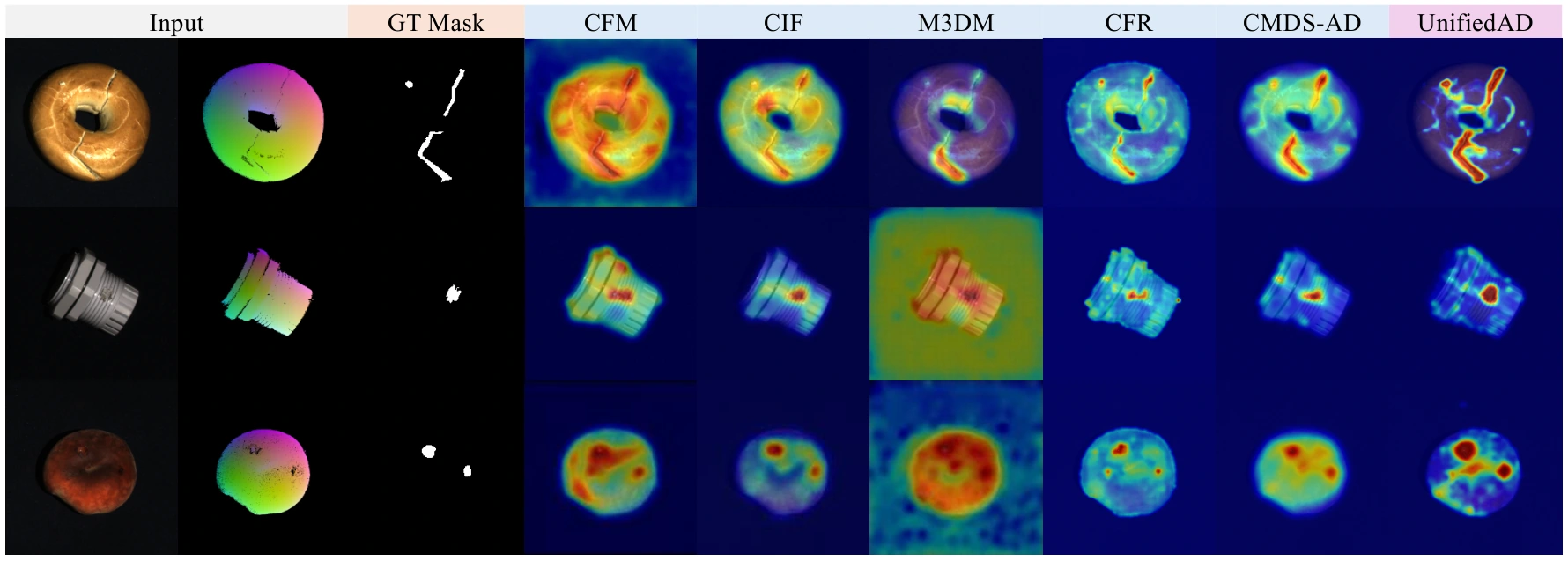 Enlarge ↗
Three examples pair color and geometry inputs with a ground-truth mask. The rightmost column shows the UnifiedAD map, which can be compared with the mask and the five baseline maps in the same row.
Paper, p. 6Takeaways
A detector can keep separate models of normal appearance and geometry, then combine their answers to a common question: how unusual is this patch relative to normal variation in this modality?
The one-shot budget applies to the target category. Labeled auxiliary anomalies supply the transferable prior, and the frozen encoder’s patch resolution limits how precisely the method can localize very small defects.
The reference image or scan defines the scale of normal variation for each sensor, making local anomaly evidence comparable across sensors.
Paper And Resources
UnifiedAD: One-Shot Anomaly Detection across Modalities via Evidence Calibration
Paper Contact · shangzeli@njust.edu.cn
Cite This Paper
@misc{li2026-unifiedad,
  title = {{UnifiedAD: One-Shot Anomaly Detection across Modalities via Evidence Calibration}},
  author = {Li, Shangze and Shi, Chuancheng and Xie, Simiao and Wu, Wenhua and Zhu, Xingyu and Shen, Fei and Chua, Tat-Seng},
  year = {2026},
  eprint = {2611.32551},
  archivePrefix = {arXiv},
  url = {https://arxiv.org/abs/2611.32551}
}