
At A Glance
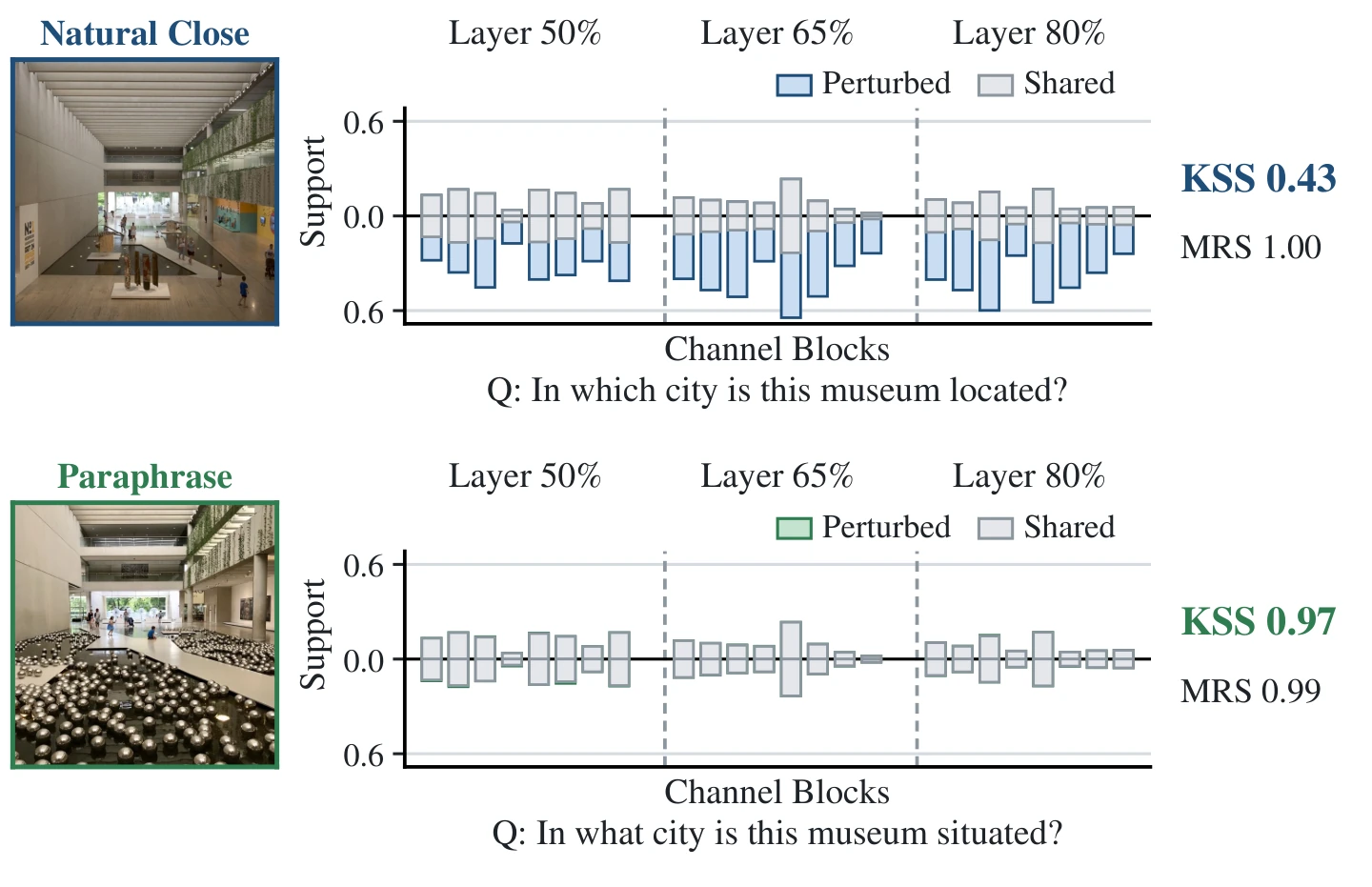
LLaVA-1.5-13B sees a museum and is asked which city it is in. A paraphrase elicits “Brisbane.” A closer photograph elicits “Brisbane” again. Inside the model, the pattern of activations supporting that answer changes much more for the closer view.
MMStableBench makes this comparison across 15 multimodal models from four families. Each four-choice item tests one fact under a reference input and five variations. Two scores track the initial answer’s lead over its competitors and the internal support for a correct answer.
- Facts about species and landmarks
- 19,452
- Multimodal models across four families
- 15
- KSS for a paraphrase and a closer view of the same museum
- 0.97 → 0.43
Research Question
An answer can lose much of its lead and still win. It can also keep its lead while different channel groups contribute to it. A count of correct answers misses both changes. Matching photographs of the same entity and equivalent questions makes it possible to study them one fact at a time.
Method
- We start with 19,452 facts about species and landmarks. We compare each reference question with a paraphrase, a closer photo, a more distant photo, shuffled answer choices and a translation. We match choices by meaning across conditions.
- We compute the margin retention score (MRS) for every item. We project changes in the decoder’s hidden states through the reference logit Jacobian to estimate the loss of the original answer’s lead over competing choices.
- We compute knowledge support-structure stability (KSS) on reference-correct items with identifiable support. We hold the gradient of the correct answer’s margin over its strongest rival fixed. We measure how much the positive contributions of groups of channels overlap across inputs, accounting for their distribution and total magnitude.
 Enlarge ↗
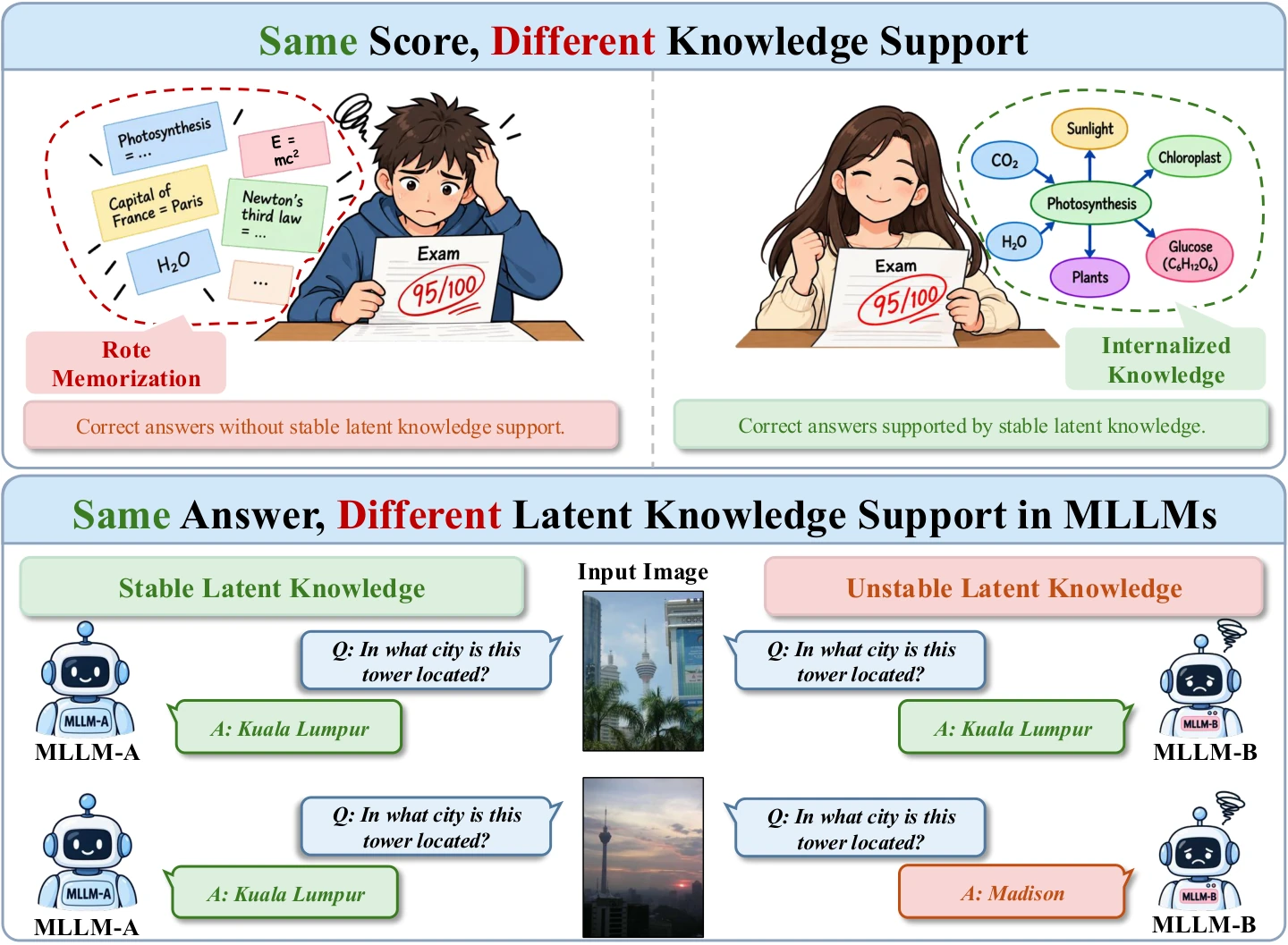
In our example, two models locate the tower in Kuala Lumpur in the first photograph. One model changes its answer when shown the second view.
Paper, p. 2Evidence
For the Brisbane museum question, the paraphrase and closer photo yield MRS values of 0.99 and 1.00, respectively, but KSS values of 0.97 and 0.43. Across models, 12.4% of correctly answered perturbed inputs in the highest MRS quartile fall in the lowest KSS quartile.
An editing experiment on 955 visual-entity instances in MMKE-Bench adds a margin-retention regularizer to two editors for LLaVA-1.5-7B. On new images of the edited entity, token-level accuracy rises from 49.30% to 53.06% for FT-LLM and from 46.29% to 48.33% for KE.
 Enlarge ↗
The closer view is above and the paraphrase below. Both preserve the lead of the correct answer, while the channel contributions at three decoder depths shift more for the closer view.
Paper, p. 6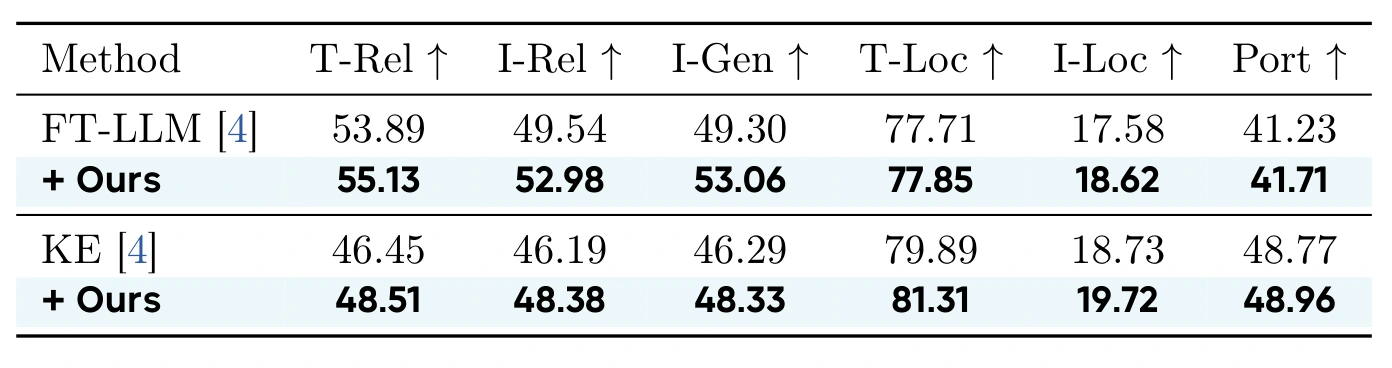 Enlarge ↗
For LLaVA-1.5-7B, I-Gen measures token-level accuracy for the edited answer on a new picture of the same entity. The rows pair each editor with its regularized version.
Paper, p. 9Takeaways
These measurements help locate what changes when an input varies. In the museum example, the answer retains its lead even as the support across channels shifts. The editing experiment gives that distinction a practical test by checking whether a fact learned from one image carries over to another image of the same entity.
To evaluate a correct answer, ask how its margin and internal support respond to a change in wording or viewpoint.
Paper And Resources
Evaluating Latent Knowledge Stability in Multimodal Large Language Models
Paper Contact · cshi0459@uni.sydney.edu.au
Cite This Paper
@misc{shi2026-mmstablebench,
  title = {{Evaluating Latent Knowledge Stability in Multimodal Large Language Models}},
  author = {Shi, Chuancheng and Li, Shangze and Wu, Wenhua and Cheng, Zifeng and Shao, Pengyang and Shen, Fei and Chua, Tat-Seng},
  year = {2026},
  eprint = {2611.32566},
  archivePrefix = {arXiv},
  url = {https://arxiv.org/abs/2611.32566}
}