
At A Glance
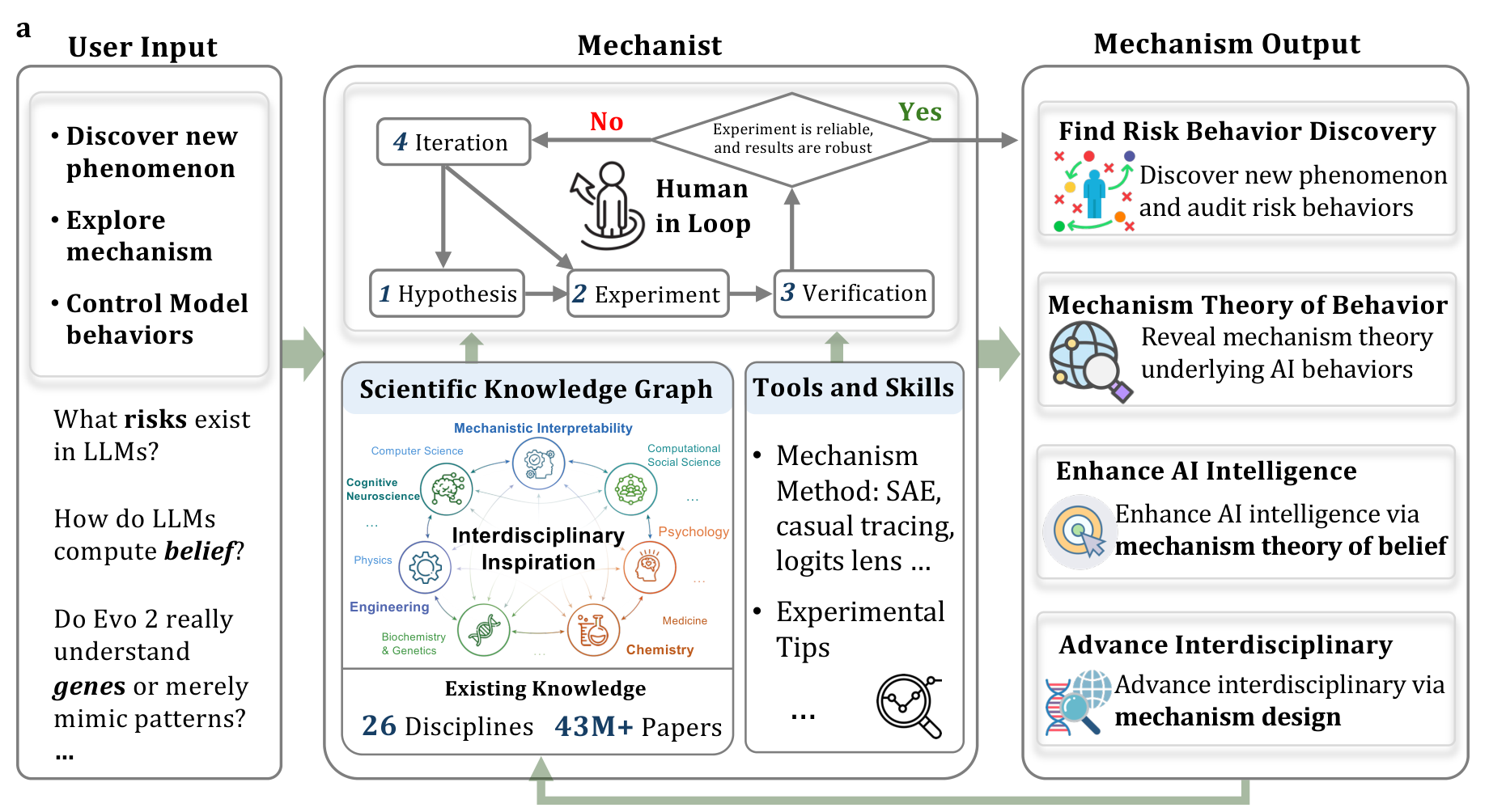
A researcher gives Mechanist a question about model behaviour. The system consults the literature, proposes an explanation, runs experiments and checks whether its findings survive changes in method, data or model.
In the belief-reasoning study, it identifies attention heads with different roles. Some help preserve a factual answer in the presence of a mistaken belief. Others help report the belief attributed to a person in the prompt.
- Stages in the research workflow
- 4
- Mechanistic methods in the paper
- 32
- Attributed-belief accuracy before and after ablation
- 86% → 34%
Research Question
Suppose Lin believes that Venus is closest to the Sun. Asked which planet is closest, a model should answer Mercury. Asked which planet Lin would name, it should answer Venus. A model that says Mercury both times would pass a factual test while missing the speaker’s point of view.
Method
- Use three questions about the same fact. Ask for the fact alone, ask for it after introducing a conflicting belief, then ask what the other person believes in that same context.
- Rank attention heads by their importance to the tasks. Silence selected heads, compare the change on each question type, and repeat with randomly chosen heads as a control.
- Track performance and the effects of these interventions across pretraining checkpoints. Test whether the pattern also appears in a different model family.
 Enlarge ↗
Four stages propose explanations, run experiments, check the evidence and revise the plan. Verification can send a weak result back to the stage that produced it.
Paper, p. 3Evidence
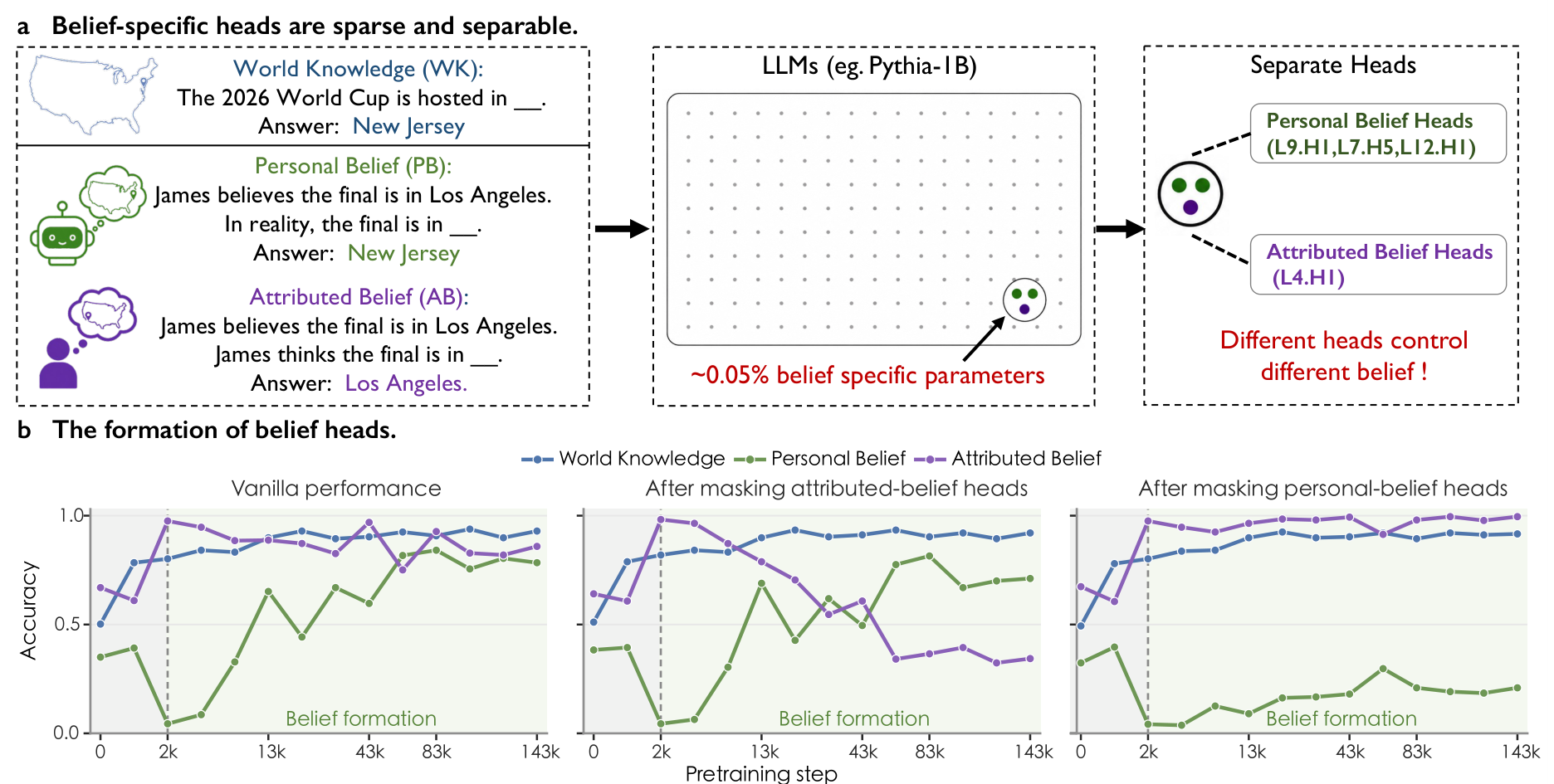
In Pythia-1B, silencing one head associated with reporting another person’s belief reduced accuracy on that task from 86% to 34%. Random-head controls had little effect. This comparison links a specific component to the change in behaviour.
Reporting the attributed belief emerged earlier in pretraining than recovering the factual answer in the face of a conflicting account. The authors also tested the distinction between the two kinds of computation in OLMo.
 Enlarge ↗
Panel a defines three question frames. Panel b follows accuracy across checkpoints. Comparing the curves with different heads silenced reveals when each set of heads begins to matter.
Paper, p. 7Takeaways
The design suggests three questions for studying other kinds of latent knowledge. Which kind of judgement failed? Which failures increase when an internal component is changed? Does the explanation still work on another model or dataset?
Here, belief has an operational meaning defined by the questions. The experiments test how a model selects knowledge in context and which components participate in that choice.
Paper And Resources
Mechanist: AI as a Scientific Instrument for Discovering the Mechanisms of Intelligence
Mengru Wang, Junfeng Fang and Shuofei Qiao contributed equally.
Cite This Paper
@misc{wang2026-mechanist,
  title = {{Mechanist: AI as a Scientific Instrument for Discovering the Mechanisms of Intelligence}},
  author = {Mengru Wang and Junfeng Fang and Shuofei Qiao and Zhenqian Xu and Haoming Xu and Haoxiong Wang and Shumin Deng and Linyi Yang and Xin Xu and Yunzhi Yao and Dan Zhang and Fei Shen and Zhixiang Cui and Buqiang Xu and Haozhe Luo and Yunxiang Wei and Ningyu Zhang and Julian McAuley and Tat Seng Chua and Huajun Chen},
  year = {2026},
  eprint = {2608.12036},
  archivePrefix = {arXiv},
  url = {https://arxiv.org/abs/2608.12036}
}
News And Commentary
- AI开始「研究自己」:Mechanist开启机器智能机制科学机器之心 Pro · 新浪科技 · Media Coverage ·
- Mechanist: Turning AI Into a Tool for Discovering How AI (and Maybe Minds) Actually WorkAnupam Srivastava · Substack · Independent Commentary ·