
At a glance
TraceRouter studies safety through paths connecting internal components. It localizes sensitive onset layers, uses sparse features to trace relevant attention interactions, and applies path-level suppression through a focused intervention. The goal is to interrupt the information flow associated with unsafe behavior while preserving general model utility.
The work evaluates both diffusion and language models, pairing safety measurements with quality or utility measurements. Its analysis shifts attention from where a feature exists to how that feature participates in downstream computation.
- Stages of pathway tracing
- 3
- Sparse feature isolation
- SAE
- Intervention-derived influence
- FIS
Research question
Distributed harmful computation can continue through multiple layers even when a local feature is suppressed. A defence therefore needs to examine how the information propagates.
Method
- Locate a sensitive onset layer through attention-divergence analysis.
- Use SAEs and differential activations to isolate malicious features.
- Estimate feature influence with zero-out interventions and suppress selected downstream pathways.
 Enlarge ↗
Layer-wise sensitivity scores identify candidate onset layers across three model families.
Paper, p. 3Evidence
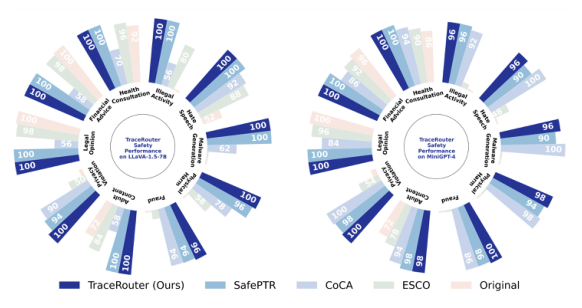
Reported comparisons examine adversarial robustness together with general utility. The results support the value of tracing and suppressing selected propagation pathways rather than treating safety as a purely local feature intervention.
 Enlarge ↗
Original model-level comparisons report safety outcomes on multimodal language models.
Paper, p. 5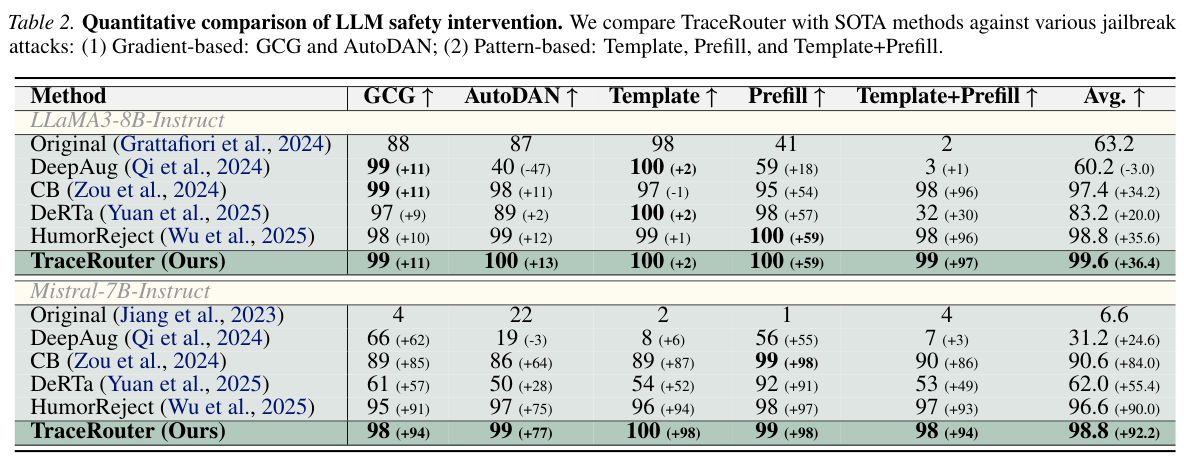 Enlarge ↗
The table compares interventions across gradient-based and pattern-based attacks on language models.
Paper, p. 5Takeaways
This gives interpretability a more relational target. Two components can matter because of the route linking them, even when neither isolated component fully explains the behavior. Tracing that route can make an intervention more specific about where and how it acts.
The practical challenge is selectivity across tasks and model families. Path-level evidence offers a way to reason about that selectivity, while the reported evaluations define the settings in which suppressing the selected routes improves safety with limited utility loss.
A behavior can depend on a route through the network, making information flow a useful unit of intervention.
Paper and resources
TraceRouter: Robust Safety for Large Foundation Models via Path-Level Intervention
Paper contact · cshi0459@uni.sydney.edu.au